2026 Tax Credits Get Real in Colorado

Filing taxes may be a familiar drill for you. Accumulating tax credits is like earning reward points, making your bills smaller. However, after years of unlimited credit claiming in Colorado, there’s now a ceiling.
Your immediate reaction may be “How do we plan around this?” Do you frontload qualified investments or spread them out? Do you even count on them?
These questions can be answered by a professional tax accountant. Before drafting a new tax approach, read about what’s changing in your state and how it affects your situation.
Featured Topics:
What is the Change to Colorado Tax Credits?
Signed into law in May of 2025 was HB25-1296, the bill that made various changes to Colorado tax credits and exemptions.
Colorado residents are seeing this bill as a campaign against TABOR, the Taxpayer’s Bill of Rights, which limits how much tax revenue the state can keep each year. When collections exceed the cap, the surplus gets refunded to taxpayers.
Tax expenditures get their name because they represent foregone revenue. When the state gives a credit or deduction, it’s choosing not to collect money it otherwise could. HB25-1296 is Colorado recalibrating those choices.
The bill is projected to affect the following areas on an ongoing basis:
- State Expenditures: Funding for homestead exemption reimbursements is expected to increase, impacting general fund expenditures.
- State Revenue: Expect restrictions on Enterprise Zone credits and modifying exemptions for software and telecommunications, in efforts to increase revenue.
- TABOR Refunds: Governor Jared Polis said Colorado residents won’t get refunds from the Taxpayer’s Bill of Rights. The bill could increase the total TABOR refund obligation, and the state will be about $308 million below the TABOR cap.
- Local Government: The changes to tax credits can reduce tax benefits for businesses operating in those zones. However, businesses may apply for a waiver to exceed the cap if they can demonstrate significant economic benefits to the Colorado Economic Development Commission.
These changes are intended to simplify tax processes, reduce administrative complexity, and make Colorado’s tax code more consistent with other states. Some breaks were extended, such as the childcare credit, which now runs through 2030. Others are trimmed or eliminated, like the business personal property credit, which ended after 2025.
Tax compliance isn’t supposed to be simple, but it used to be more stable. These changes will affect your taxes, either as an individual or as a business owner, so it’s important to understand how.
How Colorado Credits are Affected
This year, tax expenditures stopped being theoretical. Colorado’s bill adjusts seventeen different tax provisions, from medical marijuana application fees to historic preservation credits to the senior property tax exemption. Most are technical tweaks that affect specific populations, but the enterprise zone cap affects anyone who’s made substantial investments in economically distressed areas.
Here are the biggest changes to take note of in 2026:
Enterprise Zone Investment Tax Credit
The bill restricts the industries eligible for investment tax credits. Under the old rules, you could use all the accumulated credits from a manufacturing expansion. Eventually. The new rules require exemption approval from half, or they’ll evaporate.
The bill completely excludes certain industries from claiming the credits:
- Oil and gas extraction
- Aviation
- Fuel retail
- Wireless telecommunications infrastructure
Let’s look at an example:
A client planning a multi-year development project in an enterprise zone could previously forecast the tax benefit with confidence. Now, they’re forecasting $2 million for certain, and everything else as a maybe.
It’s important to have the right tracking methods in place moving forward. Understand which credits have caps, which phase out, which require specific documentation, and which depend on annual legislative decisions about what constitutes an economic emergency or public benefit.
Business Personal Property Tax Income Tax Credit
Income tax credits for personal property taxes have been eliminated, where before, companies could claim the first $18,000 worth of their property. It is replaced with a new, broader credit based on the average tax paid on $50,000 of property, subject to specific adjustments.
Income Tax Addition for Overtime Pay
The bill also does something quieter but equally significant. Overtime pay exclusions are added back into state taxable income. Workers who previously excluded overtime from federal taxes will now pay Colorado income tax on it.
The new revenue generated for the state doesn’t come from corporations or manufacturers, who pay far more than this on their investments. It comes from the paychecks of people working extra hours.
If you’re calculating Colorado taxable income, overtime doesn’t disappear the way it used to. If you’re planning for property taxes as a senior, you have certainty through 2026.
The overtime adjustment, enterprise zone cap, and inclusion of overtime each require different documentation, different timing, and different client conversations. Businesses and individuals should review how the new laws impact their 2026 filings. It’s time to start having those conversations now.
Common Questions About Colorado Tax Changes
Before you meet with a professional tax advisor, we may be able to answer some of your questions right now.
Q: What happens to the amount that exceeds the cap for accumulated enterprise zone credits?
You can claim $2 million in annual benefits with certainty. For amounts exceeding the cap, you must apply for an exemption from the Colorado Economic Development Commission. The approval criteria and process are still being established, so it’s best not to assume those credits are guaranteed.
Q: Am I affected if I’m exempt from federal overtime taxes?
If overtime was previously excluded from your federal taxable income, it now gets added back for Colorado state income tax purposes. Expect higher Colorado tax liability on those hours starting in 2026.
Q: Can I still claim enterprise zone credits if my business operates in oil and gas?
Starting January 1, 2026, oil and gas extraction, aviation, fuel retail, and wireless telecommunications infrastructure are completely excluded from eligibility for enterprise zone credits.
Q: Will my TABOR refund be smaller this year?
Yes. The 2025 TABOR surplus is projected at $296 million, resulting in significantly lower refunds issued in past years. Your TABOR refund will depend on your income.
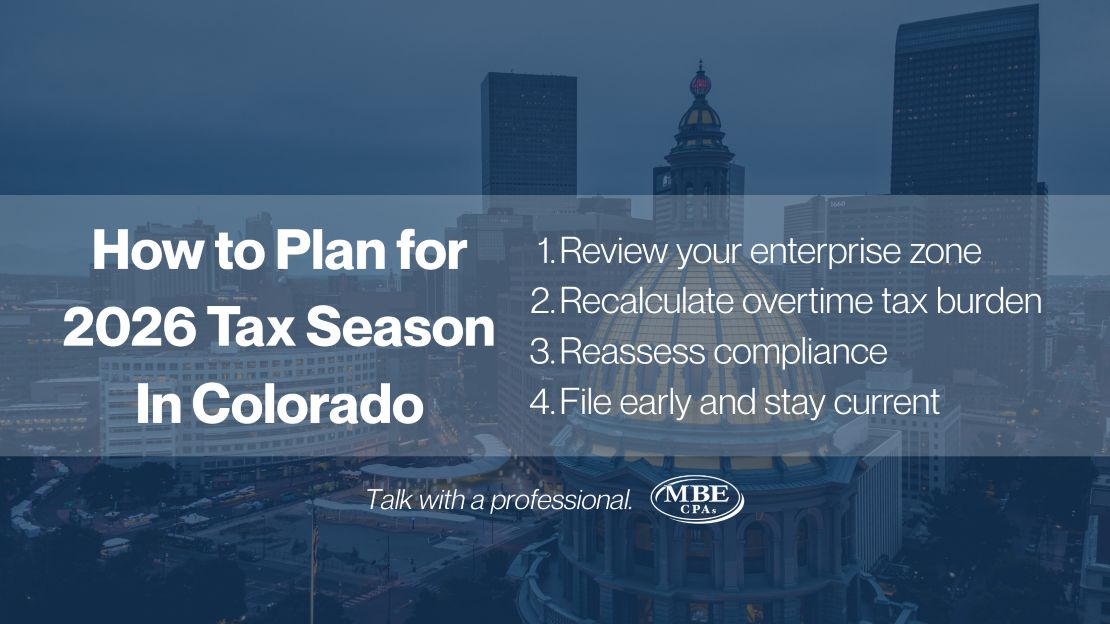
How to Plan for 2026 Tax Season
This accounting challenge is complex, and it’s in effect. Before, enterprise zone credits were a sweetener for expansion decisions. Now, they’re a component that requires active management.
When understanding your tax situation, here are several actions to consider:
- Review your enterprise zone: Understand the exemption process and don’t assume credits beyond the cap will be available. For businesses in the excluded industries, adjust your capital investment planning accordingly
- Recalculate overtime tax burden: Employees receiving overtime pay should expect a higher tax liability. Review your withholding to avoid underpayment penalties.
- Reassess compliance: With the elimination of the business personal property tax credit for most taxpayers, business owners need to check for accurate collection and remittance of state and local sales tax.
- File early and stay current: The more credits you’re tracking, the more important early filing becomes. Staying ahead on documentation will be the first step in maintaining compliance.
From an accounting perspective, what’s notable is the compression of changes. Different provisions take effect on different dates, affect different taxpayers, and have different consequences. For accountants, this policy discussion is a deadline calendar requiring a series of conversations about what the numbers actually mean this year.
If you’re still trying to get used to explaining how your numbers are different, start explaining your numbers to a professional. At MBE CPAs, we’re trained to understand the tax changes that affect your situation so you can focus on your business. Start your conversation before it’s too late.