Thank the IRS for Your Higher Paycheck

Authored by: Brett Leibfried — Partner, CPA | Date Published: February 23, 2026
Starting in 2026, you may have been fielding questions from your employees. “Why did my paycheck change?”
The IRS has implemented significant changes this year that are increasing the numbers you see on your pay stub. While this is a positive change, it can also create opportunities. Opportunities to save more, plan smarter, and potentially keep hundreds of dollars out of the IRS’s hands come tax time.
What are you going to do with the extra dollars? Before you miss your chance, let’s continue saving them.
Featured Topics:
What is the Annual Tax Adjustment Cycle?
Every year, the IRS adjusts tax brackets to account for inflation, but 2026 brings more than just the usual tweaks. Understanding what’s happening requires looking at both the routine adjustments and the new legislative changes.
If you haven’t heard of bracket creep, we’ll break it down. This happens when inflation pushes taxpayers into higher brackets even though their purchasing power hasn’t increased.
For 2026, these adjustments are more substantial than in recent years. Lower-income brackets are rising by approximately 4%, and higher-income brackets are increasing by roughly 2.3%.
The adjustments to tax brackets are made annually to prevent this. How we approach payroll withholding calculations and year-end tax planning is determined by these changes.
Let’s look at how this affects your tax situation.
The Key IRS Changes in 2026
Let’s break down what’s actually different about your taxes this year and why it matters.
The standard deduction has increased across all filing statuses:
- Married couples filing jointly: $32,200 (up from the previous year)
- Single taxpayers and married filing separately: $16,100
- Heads of household: $24,150
Advisor tip: These figures reflect the base standard deduction. Taxpayers age 65+ or those who are blind may be eligible for additional deductions, which can materially change their tax income.
For business owners, it’s important to understand that while your employees see personal improvements, business deductions follow different rules. Knowing the changes to your employees’ tax situation can help you structure compensation packages more effectively.
Additionally, the 2026 tax year introduces temporary deductions:
- Tips and Overtime: Specific workers may see reduced taxation on these income categories.
- Vehicle Loan Interest: A temporary benefit for those financing vehicles.
- Enhanced Child Tax Credit: Increased benefits for families with qualifying children.
Where an individual taxpayer can substantially reduce their tax burden with these changes, a business owner needs to pay close attention to job costing and profitability analyses. The overtime deduction change will affect how you calculate the true cost of overtime work.
Tax Implications in the Real World
From an accounting perspective, we see both red flags and advantages that business owners and taxpayers might miss.
To give you real insight into how you could be impacted, here are real-world applications.
The Difference Between Cash Flow and Tax Liability
Your pay stub tells a story. Let’s say you discovered that while your federal withholding decreased by $150, your health insurance premium increased by $15. Right now, the insurance increase ate a small chunk of your win before it reached your bank account. You’ll feel like you only earned $135 by this change. However, when you file your return at the end of the year, you will have avoided giving the full $150 decrease to the IRS, and you’ll feel a whole lot richer.
If your federal withholding dropped significantly but your insurance costs rose, you might not see the difference in take-home pay, but instead on your tax return. Understanding the difference between cash flow and what you owe the IRS is the first step to mistake-free financial planning.
Taxes for the Self-Employed
Understanding whether you’re withholding the right amount requires accounting judgment. A business owner can’t just run the tax estimator and call it done. You have self-employment tax, potential quarterly estimates, and fluctuating business income. Your withholding strategy needs to account for both your W-2 income, if you pay yourself a salary, and your business profits.
As a self-employed business owner, you are the business for tax purposes. Don’t forget that this year, the first quarterly estimated tax payment for 2026 is due April 15th. These payments are based on what you expect to make all year, divided by four, so don’t assume that last year’s estimates will reflect this year’s.
The “Temporary” Red Flag
From an accounting perspective, the word “temporary” is a red flag. These provisions could expire, change, or be extended, and if you want to qualify, documentation is critical. The IRS will want proof.
Your record-keeping needs to be impeccable because if you’re audited in 2028 about your 2026 return, you’ll need clear, consistent documentation.
Here’s how you can organize now:
- Create separate folders for business and personal. Commingling records is the fastest way to miss deductions or trigger audit flags.
- Track every expense category that could yield a tax deduction.
- Properly identify your employees. If you classify someone as a contractor instead of a W-2 employee, you may face significant penalties.
The Cost-Benefit Analysis of Working with an Accountant
You may think that hiring an accountant is out of your budget. However, the time you spend preparing your own taxes, combined with DIY mistakes, might say otherwise.
For businesses, especially, here are the benefits you’ll draw from paying the accountant’s fee:
- Thousands of dollars in deductions you didn’t know existed.
- Prevention of payroll tax penalties through proper classification.
- A structured retirement plan that maximizes tax benefits and savings.
- Guidance that improves business profitability.
The ROI is clear. The partnership fee returns hundreds in identified savings, plus error prevention, plus strategic guidance, plus hours of your life back. The cost of professional guidance is almost always less than the cost of mistakes.
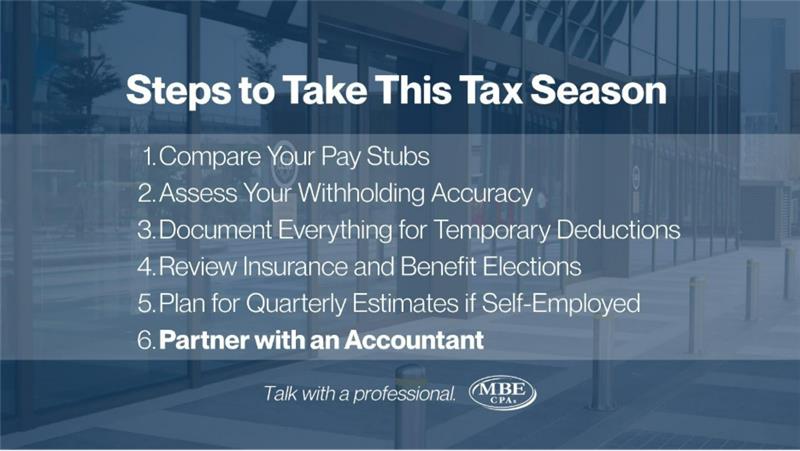
Steps to Take This Tax Season
Knowing about changes isn’t enough if you want to see the change. Here’s what you should do right now to maximize these changes:
- Compare Your Pay Stubs: Compare a pay stub from last year to see if your gross pay changed, your federal and state income tax withheld, and your pre- and post-tax deductions. Sometimes they aren’t reflected in take-home pay but instead on your tax return.
- Assess Your Withholding Accuracy: Ask yourself if you got a large refund last year, if you owed money, or if your situation has changed. These questions will help determine whether you’re over- or under-withholding.
- Document Everything for Temporary Deductions: Keep detailed records of tip income, overtime hours, loan statements, business purchases, and all W-2s. If you qualify for deductions, make sure you have proof.
- Review Insurance and Benefit Elections: Your paycheck might change for reasons unrelated to tax law. There’s a balance between tax optimization and long-term security, and a tax advisor would look at your entire financial picture, not just this year’s bill.
- Plan for Quarterly Estimates if Self-Employed: Use your profit and loss projections, self-employment tax, new deduction eligibility, and temporary provisions to calculate your quarterly estimate. A tax advisor can help with this assessment.
- Partner with an Accountant: Professional accountants provide value through accuracy, timely tax planning, and long-term financial health. We’ll work with you throughout the year, not just when you need us most.
Your 2026 paycheck changes are designed to adjust for inflation and provide targeted tax relief. But these changes only improve your situation if you understand them and act on them. Consider working with the tax team at MBE CPAs. We create customized tax strategies to improve your tax position while keeping your goals and objectives in mind.
What will you do with this break?