
Inventory Accounting Decisions That Save Manufacturers Money

Authored by: Brett Leibfried — Partner, CPA | Date Published: February 24, 2026
A manufacturer looked at their income statement, confused. Although it showed record profits, the bank account showed the opposite.
With tariffs driving up raw material costs in 2026, manufacturers using FIFO are paying taxes on phantom profits.
Here’s how switching to LIFO could save your manufacturing business six figures this year, and why manufacturers should act before Q2.
Featured Topics:
How Does LIFO Work in Manufacturing?
Think about your inventory like layers in a cake. Raw materials come in, move through production, and eventually leave as finished goods. At each stage of production—raw materials, work-in-progress, and finished goods—these products are assigned values and classified as assets because they represent future cash.
But the question that determines whether you keep that cash or send it to the IRS is: Which accounting method do I use to match my sales to my costs?
That’s where LIFO and FIFO come in.
LIFO, Last-In, First-Out, matches your most recent goods against current sales. In periods when tariff-driven costs spike, this method accurately reflects your true profit. When prices are rising and your products are high-cost, this method can help you.
Let’s say you own a metal fabrication shop:
From January 2025 to January 2026, the price you paid per ton for steel rose by over $100. Using the FIFO method, the sale matches your previous goods, showing a healthy margin. But when you use LIFO, it’s matched against the more expensive steel you just bought to replace it. Now you can see that the margins are compressed, which was hidden before.
There’s more than just this difference. Under First-In, First-Out, you’re paying taxes on that per-ton “profit” that you’ll immediately spend replacing inventory. Under LIFO, you’re only taxed on your true economic gain, and you can undertake fewer write-downs.
Where LIFO Saves Manufacturers the Most
Walk into any manufacturing plant in 2026, and you’ll hear the same frustration about stable material costs jumping over 20% in a matter of months. Any industry that faces rising costs can benefit from using LIFO. But not all materials, or manufacturers, benefit equally.
Here’s where we’re seeing the biggest impact in 2026:
- Steel and Aluminum: Tariffs combined with global supply constraints have pushed prices up nearly 20% since early 2025. Manufacturers of machinery, automotive parts, construction equipment, and structural components should consider LIFO.
- Plastic Resins: Petroleum-based material costs are up over 10% due to both tariffs on imported resins and oil price volatility. Injection molders, packaging manufacturers, and consumer goods producers are prime candidates.
- Lumber and Engineered Wood: Trade policy shifts and tariffs affecting lumber and wood products have created 8-12% cost increases. Furniture manufacturers and construction material suppliers should evaluate the benefits of LIFO.
- Electronic Components: Semiconductor and component shortages combined with trade restrictions have created supply-driven inflation. Electronics manufacturers and industrial control system producers could see benefits.
Whether the rising costs are driven by tariffs or other global changes, the method manufacturers choose to value their assets determines whether profits are real or only on paper.
Tax Complications You Need to Know
What’s the catch? A wrinkle in the proposal is that not all states follow federal LIFO election rules.
If you operate in multiple states or sell across state lines, your tax benefit calculation gets more complex:
- California only allows federal use of LIFO
- Some states require conformity adjustments that reduce LIFO benefits
- A handful of states have regulations that effectively discourage LIFO
The key is running the numbers before you make the switch, not after. When you work with a CPA, you can model state-specific impacts before making the switch. Federal savings often outweigh state complications, but you need the full picture.
At MBE CPAs, we decipher the rules and complexities of the manufacturing industry using our experience.
Is LIFO Right for Your Manufacturing Business?
Some manufacturers worry: “Won’t LIFO make my balance sheet look worse?”
Deciding between these different methods has implications for a company’s financial statements. This decision affects finished goods, cost of goods sold, and net profit, ultimately determining a business’s value.
LIFO delivers the most value when several factors align:
- Sustained cost increases.
- Consistent or growing inventory levels.
- Adequate cash flow to implement new systems.
- You’re not planning a near-term sale.
Certain manufacturing businesses have a high chance of significant tax savings with LIFO, but choosing an accounting method is not one-size-fits-all.
Warning signs that LIFO might not fit:
- Highly seasonal production with dramatic inventory swings.
- Material costs are expected to decrease.
- State tax situations where non-conformity eliminates most federal benefits.
- Very high inventory turnover, with minimal benefit.
If this analysis suggests LIFO could create significant savings, you need an action plan this year. Switching to a new accounting method might not be the only step.
If your business is ready to grow, but your organization isn’t, read this guide to predict the success of your actions.
Next Steps for Manufacturers in 2026
If LIFO could save your business five or six figures this year, time matters.
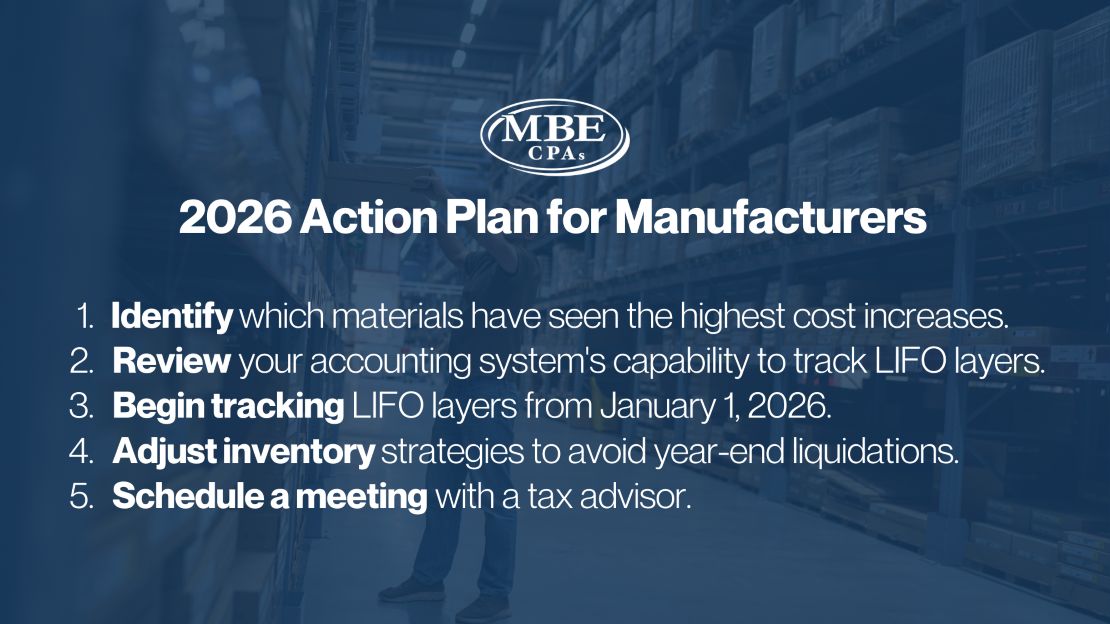
Start taking these actions now:
- Identify which materials have experienced the highest cost increases.
- Review your accounting system’s capability to track LIFO layers.
- Begin tracking LIFO layers from January 1, 2026.
- Adjust inventory management strategies to avoid year-end liquidations.
Equipment depreciation strategies work even better when paired with smart inventory accounting.
If you’re dealing with rising material costs due to tariffs, your choice of accounting method could save another six figures annually.