
Close Your Production Data and Financial Gap
Authored by: Brett Leibfried — Partner, CPA | Date Published: April 30, 2026
It’s the last week of the month, and a controller at a mid-sized facility is trying to close the books. They called the operations manager, who says multiple jobs still show as open in the ERP, but the production supervisor claims they closed last week.
This data disconnect is a struggle that manufacturers of every size deal with on repeat. While it’s fixable, there’s no one-size-fits-all answer. Here’s what you should know about data integration.
What are the Three Layers of Data Disconnect?
Every month, an in-house accounting team for a manufacturing company manually copies numbers from a production system so they can reconcile them. It takes hours and introduces errors, all because of the production-to-accounting data gap.
Production systems are built to track the physical world of manufacturing. What was made, when, and using what materials. Accounting systems represent that physical world in debits and credits. They weren’t designed to talk to each other, and the person bridging them has a large spreadsheet and patience.
This data gap operates at three distinct levels, and a successful integration strategy needs to address all three.
- Data Vocabulary Mismatches
Your production system tracks how much raw material a job consumed, while the accounting system wants to know how much direct material cost was charged to WIP inventory. These two statements describe the same event, and integration provides a translation layer between them.
- Timing Differences
Production systems record events in real time, but accounting systems record transactions weekly, monthly, or quarterly. The accrual basis of accounting requires matching costs to periods, which means the real-time production feed must be aggregated, cut off, and sometimes adjusted before it is recorded as a journal entry.Think of this like a river. Like the water, data flows continuously, and like a reservoir, the finance team needs to measure it in defined buckets. - Organizational Silos
The operations team owns the production system. Finance owns the ERP. When something breaks, these teams have different priorities and definitions of “broken.” Without shared ownership of the integration, pointing and delegating fills the gap that data should.
This gap is one of the most expensive operational inefficiencies that finance teams think are too technical and costly to fix. Integrating your data is the solution to the dreaded month-end close, which becomes outdated by the time it’s settled. Your organization just needs to decide what that will look like.
What Does Integrated Production Data Actually Look Like?
When production and accounting data are properly integrated, the finance team stops being a translator and starts being an analyst. The difference is significant.
In a mature integration:
- Cost data flows automatically from the production system into the general ledger
- WIP valuations are calculated from actual production records rather than estimates
- Variance analysis, the difference between standard and actual costs, is available within hours of production closing, not days.
The most immediate accounting benefit is access to real-time cost visibility. But while the benefits are real, so are the risks. Integration projects that fail typically fail for predictable reasons, and your accounting team should be alert to the following patterns:
- Over-automation before validation: Automating a misconfigured integration posts errors at scale. Build in human review checkpoints and expand automation incrementally.
- Inadequate change management: Production supervisors may not understand why their data entry habits now matter to the general ledger. Closing jobs correctly becomes a shared accountability to communicate and manage.
- Treating integration as an IT Project: If IT leads the integration without accounting involvement, the result will likely be technically functional but accounting-operationally incomplete.
- Neglecting the audit trail: Every general ledger entry needs a clear, auditable link back to a specific production event. Without it, you’ll create more work at year-end than you save during the year.
Organizations that navigate them successfully treat the integration as an ongoing accounting responsibility, not a one-time IT task. That mindset is built upon choosing the method that allows your team to do this with ease.

Which Integration Type is Best for Your Company?
There’s no single correct architecture for integrating production and accounting data. The right choice depends on your systems, your team’s technical capabilities, transaction volume, and the real-time visibility your business actually needs, versus what it thinks it needs.
Consider these common integration types:
Point-to-Point API Integration
For organizations using modern ERP platforms alongside production management tools, direct API integration is increasingly viable. You map the fields, define the transformation logic, and schedule the data transfer.
The advantage is directness and control. But when either system updates its API, the integration may break. This is manageable with dedicated IT support, but smaller teams might find the ongoing maintenance burdensome.
Middleware and iPaaS Platforms
iPaaS tools sit between the production system and the ERP, handling transformation, mapping, error handling, and scheduling logic in a visual, configurable environment.
For accounting teams that want visibility into what the integration is doing without needing to read code, this is often a sweet spot. If your organization already uses an iPaaS platform, adding a production-to-accounting flow often incurs only a modest marginal cost.
Data Warehouse with Finance Reporting Layer
Some organizations skip the direct system connection and pull both production and accounting data into a central data warehouse, building reporting and analysis on top of it.
If your organization’s problem is “we can’t see cost data clearly” rather than “our close process is broken,” this can be the right starting point. It creates a reconciled view that accountants can use for analysis, variance investigation, and management reporting.
Getting these answers documented before a single line of code is written is what separates integrations that stick from ones that get abandoned. An honest reflection of the accuracy of your data and the integration of your systems can help predict the success of your growth actions.
The architecture choices come next, but only after the accounting requirements are clear.
How to Begin Integration in Your Organization
Beyond the obvious efficiency improvements, like faster closes and fewer errors, manufacturers with integrated data are better positioned to make decisions about product pricing, mix, and capital investment.
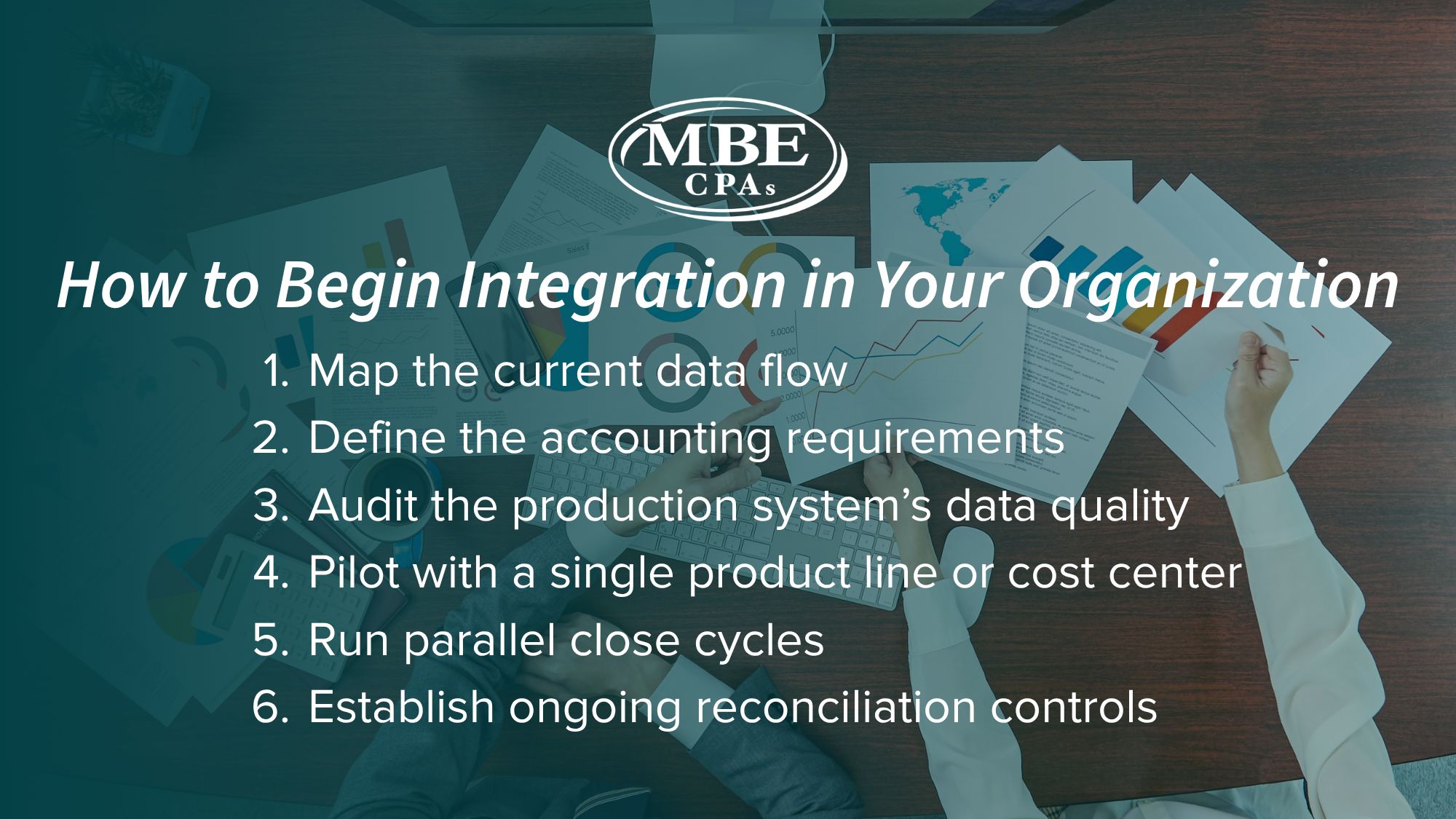
Every organization’s systems, constraints, and objectives are different. Here’s a practical framework for beginning the process:
- Map the current data flow
- Define the accounting requirements
- Audit the production system’s data quality
- Pilot with a single product line or cost center
- Run parallel close cycles
- Establish ongoing reconciliation controls
Accounting teams have always been the keepers of financial truth in their organizations. Production-accounting data integration simply extends that role closer to where economic activity actually happens: on the floor, in the machines, in the jobs running right now.
MBE CPAs can be the team to do that for you. We work with manufacturers to bridge this gap. As your dedicated partner, we work alongside you when you’re unsure where your integration stands or even where to start.
The tools to connect them are available. The accounting profession has the analytical capability to lead the effort.