
Maximizing Timber Sale Tax Benefits
Authored by: Kevin Block — Partner, CPA | Date Published: June 12, 2026
You’ve spent years, maybe decades, caring for your land. Managing your forest through both good seasons and challenging times. When harvest time arrives, the last thing you want is to overpay the IRS.
Fortunately, if you know where to look, the tax code rewards forest landowners. Timber sales can qualify for favorable tax treatment, you may have built-up tax basis you haven’t claimed, and there are deductions, credits, and programs that many landowners overlook.
This guide explains the tax benefits available when selling timber and shows you how to make sure you’re taking full advantage of them before your next harvest.
Do You Automatically Get Capital Gains Treatment When You Sell a Rental Property?
Many landowners are surprised to learn that timber sales aren’t always taxed as ordinary income, which can reach rates as high as 37%. Instead, qualifying timber sales may be taxed at the significantly lower long-term capital gains rates. Typically 0%, 15%, or 20%, depending on your income.
What Qualifies
- Outright sale of standing timber (lump-sum sale)
- Timber sold under a cutting contract where you retain an economic interest
- Timber you’ve owned for more than one year (holding period requirement)
The difference in tax bills can be substantial. Let’s break it down:
Suppose you make $100,000 from a timber sale.
– If taxed as ordinary income at the highest rate (37%), you’d owe $37,000 in federal taxes.
– If you qualify for long-term capital gains treatment (at 15% or 20%), you’d owe only $15,000 or $20,000.
That’s a savings of $17,000 to $22,000. However, this classification isn’t automatic, and how you structure the sale matters.
How Do You Establish a Timber Basis to Reduce Your Tax Bill?
Your timber “basis” is the portion of your sale proceeds that the IRS views as a return of your original investment. Not taxable gain. If you paid $200,000 for a forested property, a portion of that purchase price belongs to the timber on it. That portion is your timber basis, and it reduces your taxable gain dollar-for-dollar. The problem is, most landowners never formally establish their basis. Without documentation, the IRS will assume your basis is zero, meaning every dollar of your timber sale is treated as taxable gain.
The IRS places timber owners into one of three categories. Personal use, investor, or business. Your classification determines what deductions you can claim and how your income is taxed. Business owners have access to the broadest range of deductions, including management expenses and reforestation costs. Investors can deduct certain carrying costs. Personal use landowners have the fewest tax advantages.
How to Establish Your Basis
- Get a professional timber cruise (timber inventory and valuation) at the time of purchase or inheritance.
- Formally allocate a portion of the total property cost to timber using IRS Form T (Forest Activities Schedule).
- Keep records of any improvements that add to your basis over time, such as site preparation, planting, and pruning.
- Even if you’ve owned your land for years without tracking this, it’s not too late. A qualified timber consultant and tax professional can often reconstruct a defensible basis using historical records, appraisals, and comparable sales data.
Section 1231 and Capital Gains Treatment
If you’re an investor or business owner who has held timber for more than one year, you may qualify for favorable long-term capital gains treatment under Section 1231. This means your timber sale is taxed at a lower rate than ordinary income. If you have a net loss instead, it can be treated as an ordinary loss.
Passive Loss Rules and Casualty Losses
If you don’t materially participate in managing your timber, the IRS considers it a passive activity, meaning any losses can only offset other passive income, not wages or investment income. Those losses carry forward and can be applied when you sell the property or generate passive income in future years. Timber damaged or destroyed by storms, fire, insects, or disease may also qualify for a casualty loss deduction, generally limited to the lesser of your adjusted basis or the decline in fair market value. Business owners can typically deduct these losses in full, while the rules are more restrictive for investors and personal use owners. Regardless of classification, documenting your timber’s condition and value before and after any casualty event is essential.
What Are Depletion Deductions and How Do They Work for Timber?
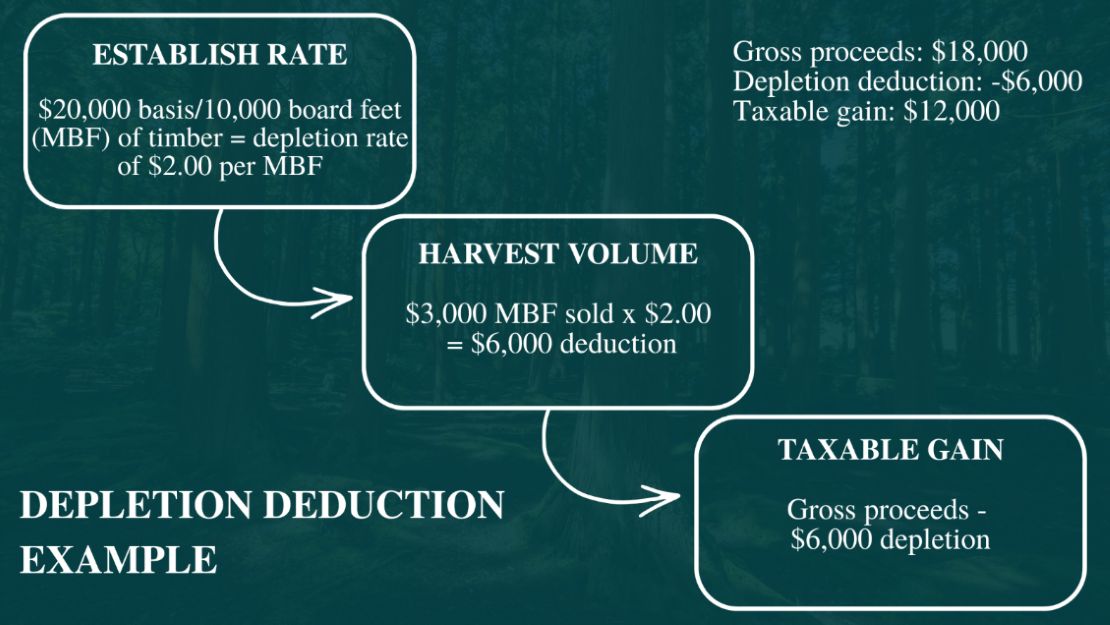
When you harvest timber, you’re drawing down a natural resource. The tax code recognizes this with depletion deductions, which allow you to reduce your taxable income to account for the “using up” of your resource.
Timber depletion is based on cost depletion (it’s tied directly to your established timber basis). As you harvest, you calculate the depletion rate per unit and deduct that amount from your proceeds before calculating your taxable gain. With a well-documented basis over time, depletion deductions can significantly reduce your taxable gain on each harvest.
Can You Get a Tax Credit for Planting Trees?
If you replant after a harvest (or plant trees on currently bare land), federal tax law offers a valuable incentive. Under IRC Section 194, landowners can:
- Deduct up to $10,000 in reforestation expenses each year per qualified timber property
- Amortize additional reforestation costs over 84 months (7 years)
Qualifying expenses include site preparation, seedlings, planting labor, and direct seeding. The key is to plan your reforestation activities with the tax benefit in mind. Timing, documentation, and property structure all affect eligibility.
This deduction requires proactive planning before the harvest is complete. Landowners who coordinate with their forester and tax advisor in advance consistently secure more of these tax benefits.
Are Cost-Share Payments for Tree Planting Tax-Free?
State and federal cost-share programs, such as the federal EQIP (Environmental Quality Incentives Program) and various state forestry initiatives, can reimburse 50% to 75% of your reforestation and conservation practices.
Under certain conditions, cost-share payments can be excluded from your gross income under IRC Section 126, making the reimbursement tax-free. The exclusion applies when the payment is for conservation practices that don’t substantially increase the land’s productive capacity.
Key Cost-share Programs to Explore:
- USDA EQIP: Covers tree planting, site prep, and invasive species management.
- USDA RCPP: Regional Conservation Partnership Program.
- State Forestry Division Programs: Varies by state.
- USDA Forest Stewardship Program: For developing a long-term management plan.
How Do You Pass Timberland to Your Heirs Without a Huge Tax Bill?
For many families, a timber harvest is connected to legacy, inheritance, and the long-term stewardship of the land. Decisions made during a timber sale can have significant estate planning consequences that are easy to overlook in the moment.
Key intersections to consider:
- Stepped-up basis at death: Heirs who inherit timber property receive a stepped-up basis to fair market value at the date of death, potentially eliminating decades of built-up gain. Timing a harvest before vs. after an estate transfer can mean different tax results.
- Installment sales: Selling timber over multiple years may allow you to spread the gain and manage your tax liability through installment sale reporting.
- Trusts and LLCs: Holding timber land in a trust or family LLC can provide estate planning flexibility while maintaining favorable tax treatment on harvests.
- Conservation easements: Placing a conservation easement on your property can generate substantial charitable deductions and reduce estate value without necessarily prohibiting future timber harvests.
The main takeaway is that proactive planning is essential to maximize benefits and avoid costly mistakes.
A Quick Planning Checklist
Use this as a starting point, then work with a qualified forestry and tax professional to personalize your approach.to date?
- Have I formally established and documented my timber basis?
- Is my sale structured to qualify for capital gains treatment?
- Am I calculating depletion correctly for this harvest?
- Have I planned reforestation activities to maximize the Section 194 deduction?
- Have I checked what cost-share programs I'm eligible for this year?
- Have I reviewed how this harvest interacts with my estate plan?
- Are my timber records (IRS Form T) up to date?
Are You Getting Everything You Can from Your Timber Sale?
Your forest took years to grow. Your tax strategy deserves the same attention. The tax code offers meaningful benefits to timber landowners, but they aren’t automatic. These advantages go to those who plan ahead, maintain thorough records, and understand how each decision impacts their bottom line. Without the right guidance, you could be leaving money on the table.
Ready to keep more of what your land has earned?
Contact MBE CPAs today to schedule a consultation with a forestry tax specialist who can review your situation and help you maximize your returns before your next harvest. a consultation with a forestry tax specialist who can review your situation and help you maximize your returns before your next harvest.
Prefer to talk directly? Call us at (608) 356-7733.