Build Lasting Confidence, Not Bigger Tax Pressures

Authored by: Glen Erdman — Director, EA | Date Published: December 4, 2025
Uncertainty is building among manufacturers as business conditions continue to deteriorate near the end of 2025. Compliance costs across the industry reach $350 billion, making fluctuating tariffs only one of the flaring concerns. Manufacturers fear that rising material costs will have the greatest impact on their future growth.
Clever financial planning no longer sets business owners apart; it keeps their company operating. Is your business prepared for the unpredictable challenges of 2026?
Featured Topics:
A Snapshot of Manufacturing Challenges in 2025
While Washington generously funds billions in reshoring American manufacturing, the real challenge is recognizing that the financial foundation to sustain these factories hasn’t yet been built.
Here are this year’s biggest challenges and updates:
- Talent Acquisition: 1.9 million manufacturing jobs could go unfilled over the next 10 years if talent challenges are not addressed.
- Tariffs: The 2025 EU/U.S. tariff framework is now settled at 15 percent for most general categories, while the original 50 percent raw material tariffs — steel and aluminum — remain in place with no indication of rolling back.
- Reshoring: Companies have increasingly been requesting quotes specifically tied to reshoring formerly European-sourced parts, especially in heavy construction equipment components. This trend is expected to continue following the heavy tariff on sourcing overseas parts.
However, one major change in 2025 was a tax incentive for manufacturers, which was three times larger than any other cut in the industry.
What does this mean for manufacturers?
Tax Opportunities in 2026
Your manufacturing company just reaped the benefits of a billion-dollar tax incentive. But will tariff chaos cost you billions more in lost opportunities?
Manufacturers are wondering how to stay one step ahead in 2026, following the challenges that have fluctuated this year. The answer? Strategic financial planning that turns uncertainty into competitive advantage.
Here’s what you can make the most of this upcoming tax season:
- The OBBBA permanently reinstates 100% bonus depreciation for eligible assets acquired and placed in service after January 19, 2025.
- Another new 100% deduction for tangible production structures, including being temporarily available for buildings placed into service before 2031. Businesses are allowed to fully deduct the cost of building new facilities if they qualify.
- Five-year amortization is restored for domestic research and development expenses in favor of immediate R&D expense.
- Updated rates and the Section 199A deduction can reduce the top marginal tax rate for qualified manufacturing income. This benefit applies to S corporations and partnerships.
Manufacturing in 2025 isn’t about predicting tariff policy—it’s about building financial resilience regardless of policy. The OBBBA provides tools to offset tariff costs, fund reshoring investments, and accelerate strategic initiatives. But these benefits require proactive planning, not reactive compliance.
If you’re considering switching to a US-based supplier, do so before the year-end. Starting now helps you stay one step ahead of the other companies waiting to act until Q4.
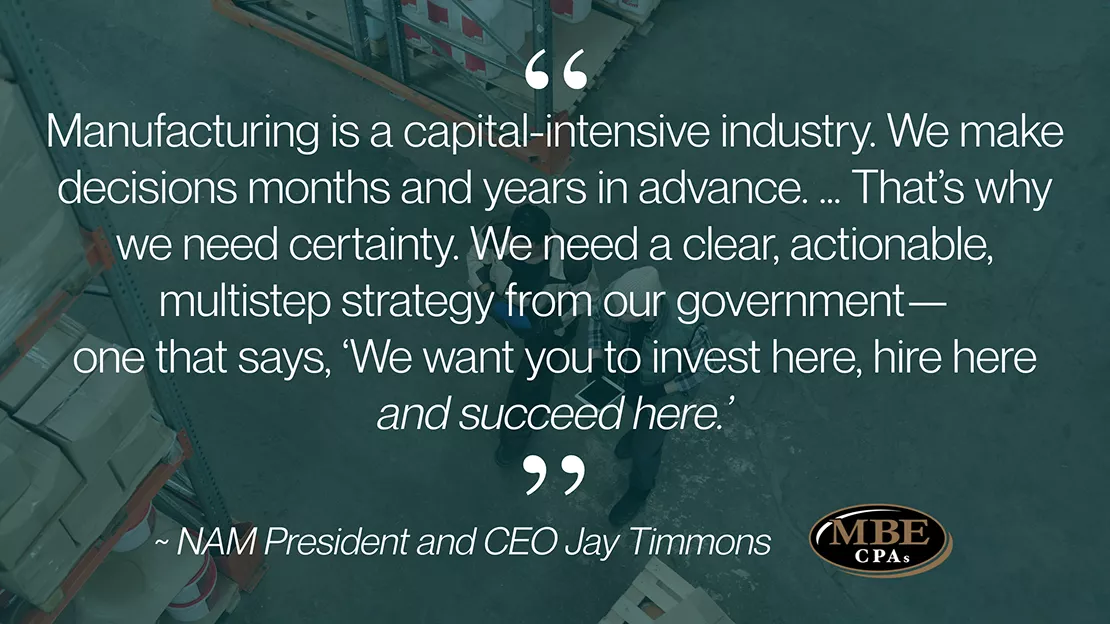
From NAM President and CEO Jay Timmons:
Common Questions About Tariffs’ Accounting Implications
The manufacturers that flourish through 2026 and beyond won’t be the ones that solely rely on the best tariff forecasts. They’ll be the ones with accounting partners who transformed their tax incentives into differentiators while competitors waited for clarity that never came.
Let’s address commonly asked questions in the manufacturing industry:
"Why are tariffs making everything more expensive?"
Specialist Answer: Tariffs require companies to assess their inventory at net realizable value, then record immediate write-downs, impacting current earnings. Let’s model your total cost under different tariff scenarios, identify duty drawback opportunities, and determine your break-even point for reshoring with OBBBA incentives factored in.
Evaluating whether pricing changes will lower the impact of increased costs can be done with an accounting team, as we will help record them properly as revenue rather than an offset to costs.
"Should we buy equipment before year-end?”
Specialist Answer: To accelerate tax deductions and reduce this year’s taxable income, it is advised that you buy necessary equipment before year-end. It is most effective to do so if you had a profitable year in 2025.
Let’s look at an example: Your million-dollar equipment purchase generates about half the return in immediate tax savings. Suppose we restructure your planned facility expansion so construction can begin by December 31. In that case, we can accelerate your additional deductions, which would have a greater cash flow impact over the next three years.
"Why are tariffs so unpredictable?"
Specialist Answer: For manufacturers, it comes down to the delayed effects on supply chains, currency markets, and inflation. It is still important to navigate these changes with clear future outcomes in mind, rather than making decisions with little notice.
Let’s establish three financial models: Base, optimistic, and pessimistic. Each illustrates your break-even points, cash flow requirements, and optimal supplier mix under each scenario. With monthly updates as tariff policies evolve, you can better predict the fluctuating project situations.
“Why is our tax liability high this year?"
Specialist Answer: OBBBA has adjusted many standard deductions and tax brackets for inflation, which should benefit manufacturers. If your tax liability is higher, it is likely due to insufficient tax withholding, multiple income streams, an increase in capital gains, or other factors that occurred before the changes implemented in 2025.
As an eligible small manufacturer, have you filed amended returns for 2022-2024 to claim immediate R&D deductions? Combined with your 2025 bonus depreciation election and FDDEI optimization, your effective rate will likely drop.
How to Prepare for the 2026 Tax Season
The window for 2025 tax optimization closes December 31st. By scheduling your manufacturing tax planning session before December 15th, you can:
- ✓ Model your reshoring economics with OBBBA incentives factored in.
- ✓ Identify immediate equipment purchases qualifying for a 100% deduction.
- ✓ Assess retroactive R&D deductions (2022-2024) if eligible.
- ✓ Optimize entity structure with permanent QBI deduction.
- ✓ Build scenario plans for tariff uncertainty.
- ✓ Capture year-end opportunities before they expire.
Learn how you can further your proactive planning and take advantage of manufacturing opportunities to carry your success well into 2026.
By scheduling a consultation with MBE CPAs, you can design a plan for the upcoming tax season. The decisions you make in the coming weeks will help you understand as a business owner if you have captured every available tax deduction and credit available to you.
Our team at MBE CPAs will guide you through R&D credit identification and documentation, proper expense classification to maximize benefits, and coordination with state R&D credits. We’re qualified to help you build your credibility as a capable manufacturer, starting with capturing emerging tax benefits while building tariff resilience.