Buy Equipment Smarter Under New Depreciation Rules

Authored by: Brett Leibfried — Partner, CPA | Date Published: March 17, 2026
That $500,000 CNC machine you’re planning to buy? Under the One Big Beautiful Bill Act, you can now deduct the full cost in the year it’s placed in service. Permanently. But only if you understand how 100% bonus depreciation interacts with the new Section 179 limits, your QBI deduction, and the timing traps.
Even without the phase-down, these changes can still cost you thousands.
Understanding the Reinstated Bonus Depreciation
The Tax Cut and Jobs Act included significant changes to the tax code. However, its provisions were temporary and set to expire at the end of 2025 by OBBBA, reverting those tax laws which includes 100% bonus depreciation.
- The old rule: Bonus depreciation was on a phase-down schedule of 40% in 2025, 20% in 2026, and eliminated by 2027.
- The new rule: OBBBA made 100% bonus depreciation permanent. Qualifying assets can be fully deducted, with no phase-down, in the year they’re in service.
There’s no more deadline pressure, but the placed-in-service date still matters. Even with permanent 100% bonus depreciation, the clock starts when your equipment is ready and available for its intended use.
If you’re planning a major equipment purchase late this year, it’s important to work backward. Factor in time for shipping, installation, and testing, so you’re well aware that 2026 purchases are 2027 tax events.
What’s the New Expensing Category?
OBBBA continues to introduce new changes that impact manufacturers.
This time, it’s a temporary 100% expensing election for a never-before-qualifying asset category: Qualified production property (QPP).
What is QPP?
It’s a game-changer. This category covers nonresidential real property used as an integral part of manufacturing, agricultural production, or chemical refining.
QPP includes:
- Factories
- Processing facilities
- Production buildings
To qualify, construction must begin after January 19, 2025, and be placed in service before 2031. Leased property does not qualify, and portions used for non-production purposes must be segregated and excluded.
Think about it this way:
You build a $4 million facility with no non-production space mixed in, and elect QPP treatment. That full $4 million becomes an immediate deduction in the year the property is placed in service. If you’re in a 35% tax bracket, you’re looking at millions back in your pocket in year one, when it would have previously taken 39 years of straight-line depreciation to fully write off.
That’s the power of this provision. It’s a timing transformation that puts real money back in your hands when you need it most.
If you’re looking to learn more about the OBBBA changes that impact manufacturers specifically, read this blog.
For manufacturers planning new facility construction, this provision alone can accelerate deductions that previously would have been spread over decades.
What to Consider for Equipment Depreciation Decisions
Hearing “permanent 100% bonus depreciation” feels powerful, but it is not automatic, and not all manufacturing equipment is treated equally under the tax code.
Understanding what qualifies and what traps to avoid determines whether manufacturers capture the full benefit.
Although manufacturers must carefully monitor asset classifications, there are other traps to watch out for.
- Bundled Assets: Each component that an invoice lumps together may have a different recovery period or may not qualify at all. Itemizing your purchase agreement before signing can meaningfully increase your deduction.
- Critical Ordering Rule: The IRS requires that Section 179 be applied before bonus depreciation. This sequencing can be the difference between a usable deduction and a deferred one, because bonus depreciation does not have this restriction.
- The “Cash Only” Myth: Both deductions are available on financed equipment, regardless of loan-to-value or lender type. If you have beneficial ownership, you can claim bonus depreciation of Section 179 on financed equipment in the year placed in service.
To understand more about Section 179 vs. Bonus Depreciation, read this guide.
The OBBBA allows taxpayers to elect a reduced bonus depreciation rather than claiming the full 100%. Why would you choose this?
If your business is operating near break-even or expecting substantially higher taxable income in future years, electing out of full expensing can preserve deductions for years when they deliver more tax value.
To decide whether you’re taking the right steps, work with your advisor to model this before filing.
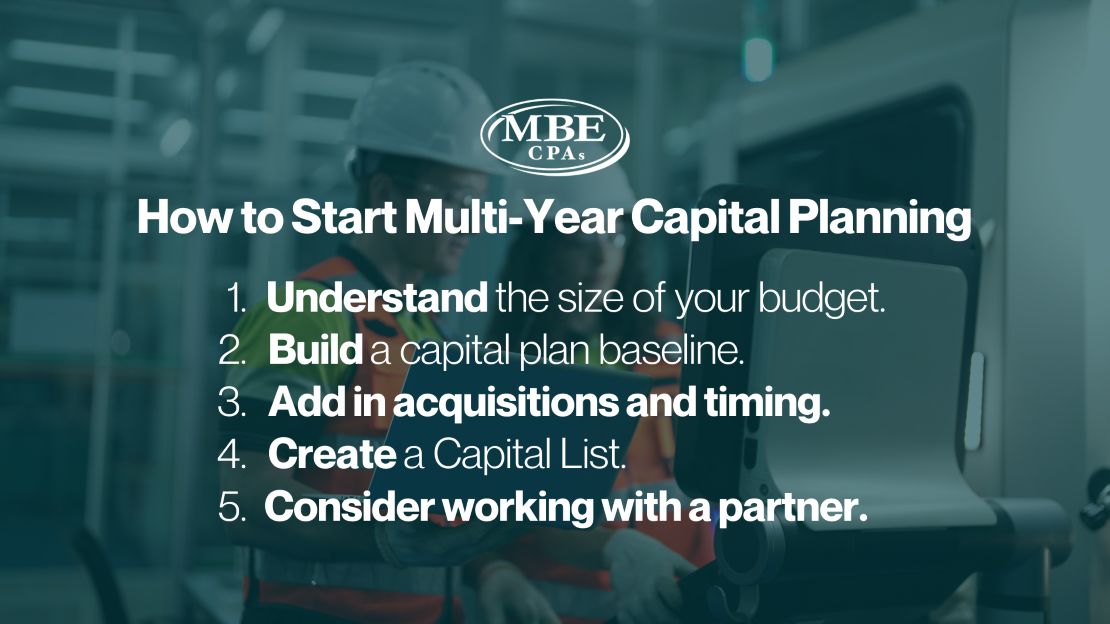
How to Start Multi-Year Capital Planning
Timing decisions made in isolation look very different when you account for the full depreciation schedule. A capital plan is a multi-year scheme reflecting timing, overall cost, and monthly depreciation.
To start the prioritization process, follow this framework:
- Understand the size of your budget. Educate yourself on your company’s financial standards, including depreciation and expense guidelines.
- Build a capital plan baseline. List current equipment and monthly costs until fully depreciated, keeping in mind your timeframe might vary.
- Add in acquisitions and timing. Factor in the gaps between the order date and installation to avoid leaving capital dollars unused each month.
- Create a Capital List. Categorize proposed purchases by replacement, current needs, or future needs.
- Consider working with a partner.
Building a sound capital plan helps balance your team’s dreams with company constraints. With permanent 100% expensing now available, it also becomes a tool for managing taxable income across years, not just within a single filing period.
Questions Manufacturers Should Ask Themselves
Production needs are driving your equipment buying decisions, but asking a few structured questions beforehand can prevent costly tax timing mistakes.
Ask yourself these questions about your proposed purchases:
- What is the expected placed-in-service date? This determines which bonus depreciation year applies, not the purchase date.
- What is our projected taxable income this year? Section 179 is capped at business income, which affects optimal sequencing. Certain exceptions apply.
- Do we have NOL carryforwards? Spreading deductions across years may be more efficient.
- What is our QBI position? Any additional depreciation may reduce the QBI deduction, partially offsetting the benefit.
- How much is the current equipment being used? This can help question category assumptions when creating buy-in alignment.
Equipment depreciation strategies work even better when paired with smart inventory accounting. If you’re dealing with rising material costs due to tariffs, your inventory method choice could save another six figures annually.
Read more about inventory accounting decisions.
If you’ve ever made a major equipment purchase only to discover at tax time that the timing cost you thousands in deductions you could have taken, you’re not alone. Most manufacturers find out too late.
At MBE CPAs, we work with manufacturers year-round, so you can approach deductions proactively. We dig into your production schedule, your cash flow cycles, and your growth plans to map out exactly when to pull the trigger on equipment purchases so you optimize available deductions or depreciation rules.
Other firms review what you did. We help you plan your next steps.