
Home Office Deductions: Rules and Record-Keeping Tips

Authored by: Kevin Block — Partner, CPA | Date Published: December 9, 2025
It’s a weekday morning, and instead of fighting rush hour traffic, you’re brewing your second cup of coffee while your laptop boots up in your converted home office. Millions of Americans have made working from home their new normal, not just for convenience. That 150-square-foot office you set up can save you on your taxes.
If you’re self-employed or running a small business from home, the home office deduction could be one of your biggest tax breaks. Let’s break down everything you need to know about claiming the home office deduction for 2025.
Featured Topics:
Why the Home Office Deduction Exists
The home office deduction has been around for decades for self-employed individuals to fairly account for business expenses. Using part of your home to generate income means you qualify to deduct a portion of your housing costs, just like you would if you rented office space downtown.
Initially, many people miss this opportunity because they don’t understand the rules or think it’s too complicated. It’s true that things get tricky, and it’s important to understand this upfront: If you’re a W-2 employee working remotely for a company, you cannot claim this deduction.
However, if you’re self-employed—whether you’re a freelancer or sole proprietor—this deduction can result in significant tax savings.
Who Qualifies for the Home Office Deduction?
Here’s what not to do regarding the home office deduction: Think that any space where you work qualifies. Your couch, where you code while watching TV, doesn’t count as your office.
To qualify for the home office deduction, you must meet two requirements:
1. Exclusive & Regular Use
The area must be dedicated solely to business activities, not dual serving as your kids’ playroom or a workout space.
Here’s what qualifies:
- A spare bedroom converted entirely into an office
- A partitioned section of a room used exclusively for business
- A detached garage or shed you’ve transformed into your workspace
Here’s what doesn’t qualify:
- The kitchen table where you eat dinner at night
- A guest bedroom where visitors occasionally stay
- Your living room couch, even if that’s where you spend 40 hours a week working
Working a hybrid schedule where you visit your dedicated office a few times a month won’t count. The space must be used consistently for business.
2. Principal Place of Business
Your home office must be your principal place of business, which is easier to meet than you might think.
Let’s look at a real-world example:
The Photographer: A freelance photographer shoots weddings and events at various locations but edits all their photos and manages their bookings from their home office. Even though their actual photography work is done elsewhere, their home office is the administrative heart of their business.
For any additional questions about whether you qualify, read more about the business use of your home.
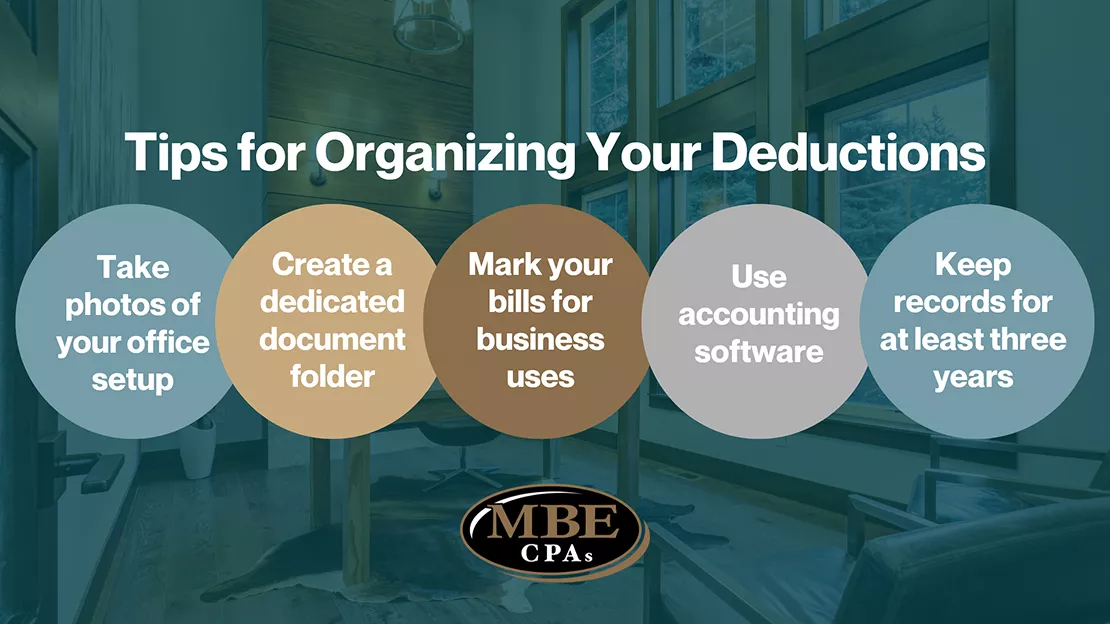
Tips for Organizing Your Deductions
You are likely to use a home office if you are a sole proprietor; therefore, maintaining detailed records of all expenses will help you effectively claim all eligible deductions on Form 1040 Schedule C.
Here are our Pro organization tips:
- Take photos: At the start of each tax year, take pictures of your office setup. This proves the space is used exclusively for business.
- Create a dedicated folder: Use a labeled digital system each year where you drop every relevant document in there as you go.
- Mark your bills: When you pay a utility bill, make a note of what percentage is for business use.
- Use accounting software: Programs like QuickBooks or even a simple spreadsheet can automatically track expenses, whether it be an invoice or a payment receipt.
- Keep records for at least three years: The IRS recommends keeping tax records for at least three years from the date you filed your return.
Learn more about how to maximize all your tax opportunities as a sole proprietor.
Special Situations & Common Questions
We know that claiming a deduction is not as simple as it seems on paper. For those of you with probing questions, we can assure you they’ve probably been asked before.
Q: “Should I use the regular or simplified method?”
The regular method: This method is for you if the business-use percentage suggests a deduction larger than the simplified method’s limit. Compute the business use of home deduction by dividing the home’s operating expenses between personal and business use.
The simplified method: Choose this method if you have a smaller office or if your actual home expenses are low. Revenue Procedure 2013-13 allows qualifying taxpayers to compute the home deduction at a rate of $5 per square foot.
Q: "What if I get audited?"
Yes, the home office deduction has been frequently flagged for audits. But if you qualify and have proper documentation, you have nothing to worry about.
Think of your documentation like insurance. You hope you never need it, but if you do, you’ll be glad you have it. Keeping complete records of your deduction method and qualified expenses may help in the event of an IRS audit.
Q: "I started my business mid-year. Can I still claim this?"
Yes, the home office expenses would be calculated based on the number of months worked. You claim the square footage of your office multiplied by the IRS rate and the amount you worked as a freelancer from home.
Q: "I have both a W-2 job and freelance work. What do I do?"
You can claim the home office deduction, but only for the portion used for that business. When an individual performs some work as a full-time employee and the rest as an independent contractor, only the independent work qualifies for the deduction.
Make sure your records clearly show that the business use is for your self-employment income.
Q: "What about when I sell my home?"
If you claimed a home office deduction using the regular method, any depreciation you took on your home office needs to be recaptured when you sell, meaning you’ll pay taxes on that portion of the home’s appreciation. This does not apply if you used the simplified method.
Your 2026 Action Plan
This deduction won’t claim itself, and the upcoming tax season will be here sooner than you realize.
Let’s turn all this information into concrete steps:
- Confirm you qualify.
- Measure your space.
- Choose your method (regular vs. simplified).
- Set up your record-keeping system.
- Track all expenses related to your business.
- Fill out your forms, or let an accountant handle them.
When running your own business, you might not have time to select a method and claim the deduction yourself. Our tax team is qualified for a reason.
At MBE CPAs, we stay up to date on the latest tax incentives relevant to your situation. With our continued support, any additional questions you may have beyond those above will be answered to help you feel confident in your financial decisions.
Measure that spare bedroom, set up your filing system, and claim what’s rightfully yours. Taking photos and saving receipts doesn’t cost you anything other than some extra record-keeping, but it could save you thousands in taxes.