What Sales Tax Rules Apply to Creamery Products
Authored by: Brett Leibfried — Partner, CPA | Date Published: April 09, 2026
Every early morning, every decision, every market conversation is poured into the products on your customers’ tables. But somewhere between the milk leaving the creamery’s tank and the money hitting your account, a question tends to arise: should you have charged sales tax on that?
Getting sales tax on your products wrong can quietly accrue until your auditor raises a red flag. Read more to find out how to get clarity on where your products actually fall.
What Product Factors Determine Taxability?
You mainly sell your dairy products in a state where direct-to-consumer sales are most active, which is great for your business.
The next step is, how do you know whether a sale is taxable?
Three factors consistently determine this:
- Processing level: The more steps a product goes through from its raw origin, the more likely it is to be taxed.
- Packaging and portion size: Single-serving packaging carries a different tax status than a block or bulk container.
- Where the sale happens: The sales channel adds layers to the economic nexus rule.
Consider three scenarios for the same block of aged cheddar:
- Sold at a farmers’ market in Wisconsin: likely exempt.
- Sold online and shipped across states: depends on the destination state’s rules.
- Sold as a gift basket with other snacks: creates the bundled product question.
None of that changes the cheese. But they do change tax treatment.
Different Ways Your Operating State Impacts Taxability
The part of taxability that still trips up experienced operators is that what’s in the product doesn’t matter, but what does is the state you’re in, how the product was processed, how it’s packaged, and where it was sold.
Let’s look at the distinctions of different dairy products:
- Raw Milk: In states where selling raw milk is permitted, it’s commonly exempt from sales tax. But “raw milk” has a specific legal definition in most tax codes that excludes any labeling, packaging, or processing steps, even if the product remains nutritionally identical.
- Aged Cheese: Some states draw a different line for sales exemption of “basic food,” classifying artisan cheeses differently than commodity blocks. Verify your state’s specific exemption language to make sure your product isn’t taxed for being specialty or gourmet.
- Ice cream: Selling as immediate consumption is taxed differently than in a take-home carton, for one is considered restaurant-style, and the other is a grocery item. Prepared food is taxable, so if you have a farm store with a ready-to-eat case, that distinction matters.
- Flavored Products: Spread, butters, or curds that are seasoned or have other added ingredients fall outside the standard food exemptions that cover basic commodities. Many states apply different rules when it comes to combining a dairy product with another ingredient and selling it as a packaged unit.
Product type alone doesn’t determine taxability, and creamery owners learn this rule the hard way. When selling different dairy commodities, it’s risky to assume that each product is taxed the same. States set different rules; it’s not blanket coverage.
When a creamery owner calls us with a question about whether a new flavored product line is taxable, we’re not starting from scratch. We know the questions to ask, the classifications to check, and the documentation you’ll need to support your position.
Check with an advisor who’s experienced in this industry. We’ll answer questions before they become mistakes.
The Most Common Creamery Tax Errors
The mistakes that creameries make aren’t careless. Instead, they’re natural results of applying general business logic to an industry with specific tax rules.
It’s not your fault, and that’s why we’re here to help.
Here’s what frequently gets flagged in audits:
- The blanket food exemption
- Ignoring the sales channel
- Missing economic nexus for online sales
- Inconsistent treatment of bundled products
The auditor’s job is to reconstruct your sales tax obligations. Your job is to make the documentation accurate, not to estimate it in their favor.
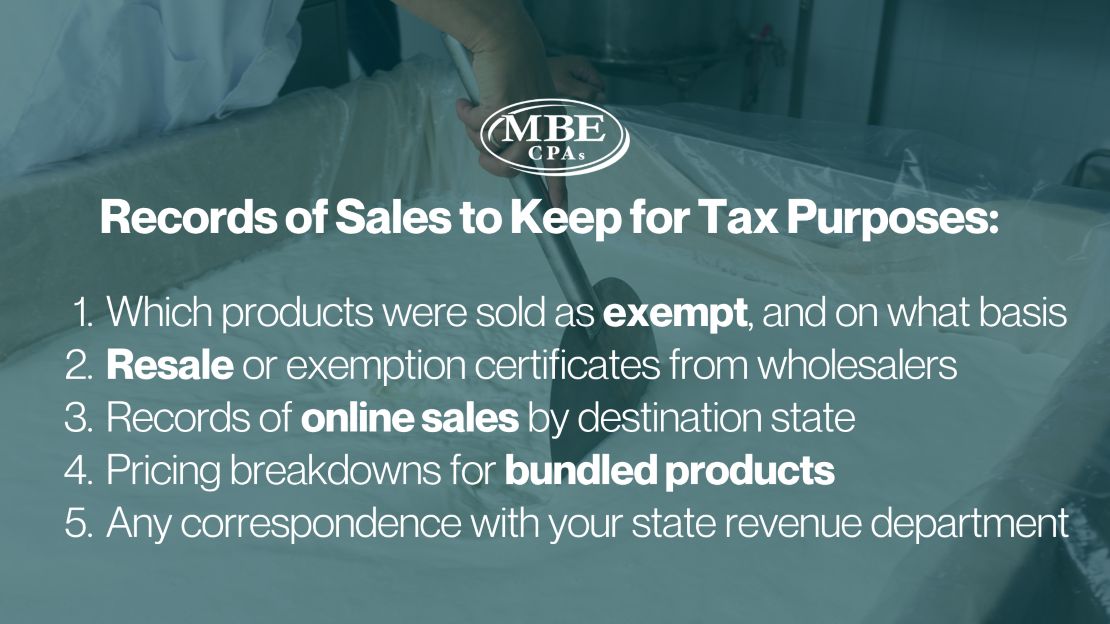
The records that matter most:
- Which products were sold as exempt, and on what basis
- Resale or exemption certificates from wholesalers
- Records of online sales by destination state
- Pricing breakdowns for bundled products
- Any correspondence with your state revenue department
Check out other smart tax strategies for creameries.
The key to record-keeping is by category organization that an auditor will use. Most creameries keep excellent production records but poor sales tax records, which creates risk.
Get Clarity About Your Sales Tax Exposure
Sales tax is an area where familiarity with general business tax law can actually make things worse. You see dairy products, apply the food exemption, and move on.
Did you know that your state distinguishes between farm store sales and market sales?
MBE CPAs works specifically with creameries and dairy operations. With our home base in Wisconsin, we’re members of the Midwest Food Products Association, and we’ve built our services around the financial and tax complexities of the dairy business. We know the nuances of your industry, not just the general rules.
Here are some of the things we do:
- Meet cash flow needs
- Secure access to capital for investments
- Prepare and organize your required financial data
- Forecasting tool to guide informed decisions
Creamery growth requires a collaborative approach. Bring your product list and your sales channels, and we’ll help you understand where you stand.