Why Meat Processors Need Pro Accounting Now
Authored by: Ryan Weber — Partner, CPA, CVA | Date Published: March 5, 2026
You’re running the meat processing business your grandfather started from the ground up. But in 2026, everything is different. Raw material costs are fluctuating wildly, and new regulations are demanding costly compliance.
Your family built the business with their hands, but if you don’t get your financial strategy right, you’ll be the one who loses it. The challenges the industry faces in 2026 will show who comes out on top and who closes their doors.
The Critical KPIs Meat Processors Must Track
While the meat processing industry has shown considerable growth, it also operates on thin margins where every cent counts. In this industry, meat processors know that growth doesn’t tell the whole story.
Your operation faces unique challenges that generic accounting can’t solve:
- Labor efficiency tracking: Labor represents a significant portion of processing costs. Are you tracking cost per head processed? Hours per thousand pounds?
- Yield management: Every animal has different yields by cut. Understanding your actual yield percentages helps identify shrink, waste, and training opportunities
- By-product revenue optimization: Hides, organs, bones can represent a large amount of revenue if properly tracked and sold.
You’re not new to these challenges. We’re not here to explain what you already know. Instead, we’ll show you how to become a thriving processor just by tracking these KPIs:
- Inventory turnover rate: Fresh meat has a short shelf life, and while frozen extends this, it ties up working capital. How quickly are you converting inventory to cash?
- Capacity utilization percentage: If you can only run a percentage of what you process, your fixed costs are killing profitability. Understanding utilization drives pricing and scheduling decisions.
- Gross margin by species and cut: Beef ribeye might generate higher margins while pork chops run lower. You need to know which products optimize profitability.
Partner with a firm that understands the operational nuances of meat processing so you can receive actionable intelligence on every animal in your facility. If having access to these detailed metrics interests you, we can help you out.
2026 Tax Opportunities You Can’t Afford to Miss
While operational excellence drives day-to-day profitability, strategic tax planning can put thousands back in your pocket. The passage of OBBBA changed taxes for meat processors who know where to look.
Let’s look at the tax credits meat processors should know about:
Increased Section 179 Deduction Limit
This influx of cash starts with the increased Section 179 deduction limit, which allows you to immediately deduct the full cost rather than depreciating equipment purchases.
What purchases qualify for meat processors:
- New or used processing equipment
- Refrigeration and freezer systems
- Food safety equipment
- Certain vehicles
- Off-the-shelf software for inventory management and production tracking
Wisconsin State-Level Tax Benefits:
Meat processors operating in Wisconsin can qualify for manufacturer classification, which exempts them from state income tax on manufacturing income.
Key qualification requirements:
- Properly documenting manufacturing activities (cutting, grinding, packaging, curing, smoking)
- Segregating manufacturing income from retail or non-manufacturing activities
- Maintaining detailed records of qualifying production activities
- Without proper accounting systems and documentation, you risk losing this exemption during an audit or failing to claim it in the first place.
These benefits aren’t fully utilized by many Wisconsin processors.
Other State Benefits Worth Exploring
Many states offer additional incentives for food manufacturers:
- Sales tax exemptions: Production equipment, packaging materials, and utilities used in manufacturing often qualify for sales tax exemptions
- Property tax abatements: Some states and localities offer property tax reductions for manufacturing facilities or equipment investments
- Job creation credits: Expanding your workforce might qualify you for state-level hiring incentives
- Energy efficiency rebates: Upgrading to energy-efficient refrigeration systems can qualify for both tax credits and utility rebates
R&D Tax Credits for Process Innovation
Many daily improvement activities for small businesses qualify as research and development.
R&D activities that qualify for meat processors:
- Development of new or improved product formulations (including flavors, marinades, seasonings)
- Process improvements to accommodate new products or reduce waste
- Modifications to processes to comply with new regulations
- Plant layout redesigns to increase throughput and reduce manufacturing time
If you’re concerned about any missed opportunities, consider partnering with a professional.
Common Questions Your Financial System Should Answer
Tax savings matter, but the real transformation comes from financial analysis that helps you make stronger operational decisions every single day. Meat processors who want to improve profitability need accounting systems that address critical business questions.
Q: Should I expand capacity or maximize current utilization?
To help answer this question, our manufacturing advisors will assess the marginal contribution of additional volume so you can see the incremental benefit of expanding your product offerings. We’ll even look at how underutilization will hurt your per-unit costs. Modeling your ROI for capital investments is an important step to avoid stretching your margins too thin.
Q: Should I finance equipment or pay cash?
The good news is that you can claim the full Section 179 deduction, even on financed equipment, in the year it’s placed in service. This means you get the tax benefit upfront while spreading the payments over time. The decision is related to cash flow and needs.
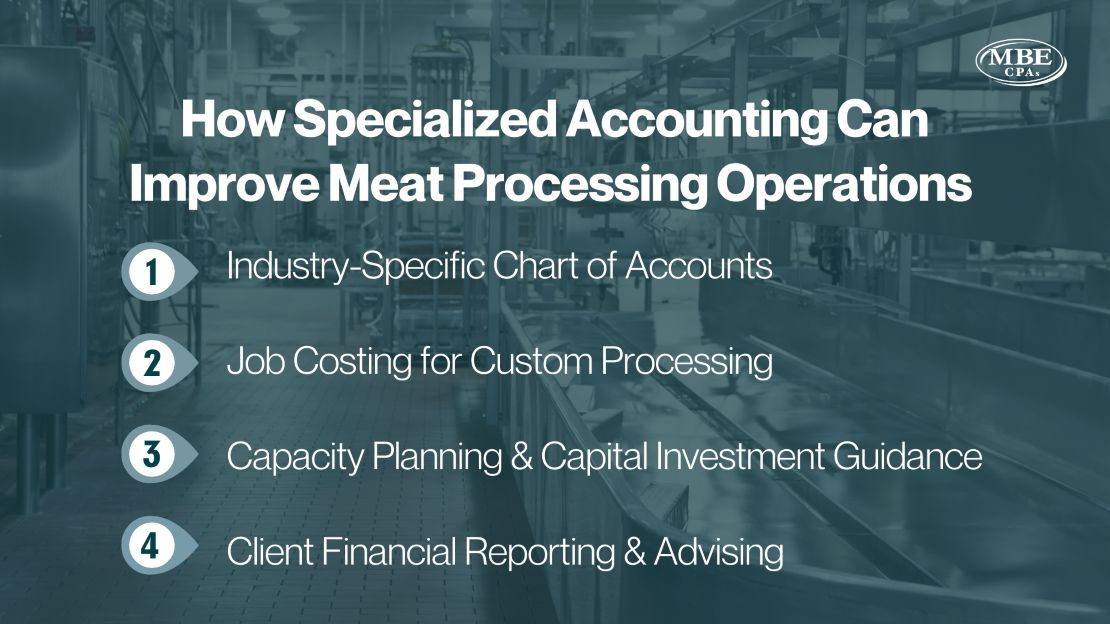
How Specialized Accounting Can Improve Meat Processing Operations
If you’re losing money month after month, it might be time to upgrade your accounting firm, just as you would upgrade your computer software or operating system.
What our specialized accountants provide:
- Industry-Specific Chart of Accounts: Our accountants understand the unique combination of food safety regulations and financial reporting in meat processing. We capture the metrics that matter, such as detailed cost centers and proper USDA-mandated cost classifications.
- Job Costing for Custom Processing: If you do custom processing for farmers and ranchers, track profitability by customer. Keep records of labor hours per job, materials used, allocated overhead, and special handling that affect costs. Identify which customers are most profitable to accurately price different service levels.
- Capacity Planning & Capital Investment Guidance: Should you invest in a new portioning system? Expand your cooking room? Add a second shift? We analyze capacity, labor costs, and ROI specific to processing operations.
- Client Financial Reporting & Advising: Most meat processors can’t justify a full-time CFO. Outsourcing solves this. Our advisors provide monthly deliverables designed for operational decision making, whether that’s profit and loss by product category or an analysis of your inventory aging.
Many meat processors are family businesses with the next generation of owners to consider. With a proper understanding of your industry, partnering with MBA CPAs will help you make better decisions, improve profitability, and build a stronger business.
While tax planning matters, our year-round financial reporting will make a bigger impact on your profitability.
Contact MBE CPAs today to learn how specialized accounting can bring your meat processing operation from surviving to thriving in 2026.