Why Strong Seasons Still Lead to Shortfalls

Authored by: Greg Patel— Partner, CPA | Date Published: April 10, 2026
You had your best summer ever. Fully booked for 11 straight weekends. But somehow, you still had to put payroll on a credit card in the fall.
If you run a seasonal lodge, inn, or resort, you already know this feeling. You’re experiencing the seasonal timing mismatch, one of the most common cash flow problems in hospitality.
Here’s why it happens, and what to do about it.
How Do Seasonal Owners Get Caught?
Let’s recall a scenario that might sound familiar, and you might’ve even experienced. From the looks of it, you’re running a successful business. Reviews are strong, repeat guests come back every year, and you even expanded your team with a front desk manager, taking that weight off your shoulders.
Summer was strong, and your bank account feels full. But when the last guest checks out in late fall, you wonder if that cash will last until Memorial Day. Property tax installments, winter maintenance, rehiring and retraining, all these costs you didn’t budget for.
Even with a record summer, you didn’t have a budgeting tool that showed you your operating runway had to last until the next season.
Whether you relate or not, these three structural problems catch seasonal lodging owners every year, regardless of how good the season was.
- Revenue Compression
- Off-season fixed costs
- Payroll mismatches
These common issues can create margin pressure: when external forces negatively affect your company’s profitability.
This section breaks down where the friction shows up in each of these traps.
The Reality of Revenue Compression
Traditional businesses earn revenue somewhat steadily throughout the year. Your business earns it in a sprint, with 80-90% of your income arriving within a three to four-month window. A lakeside resort might do 85% of its annual revenue between Memorial Day and Labor Day. A ski lodge might compress that same window into December through March.
This is what creates the problem. You must use peak revenue not just to cover expenses during that season, but also to prepay for the entire off-season.
Managing Fixed Costs During the Off-Season
Fixed costs don’t change based on your occupancy rate. Your property insurance renews whether you had three guests or one hundred that month. You push off routine maintenance like landscaping and roof inspections during the busy months, and it all tends to cluster when your cash reserves are the thinnest.
These costs tend to catch owners off guard:
- Annual insurance renewals
- Property tax installments
- Deferred maintenance and capital repairs
- Accounting, legal, professional service fees
- Pre-season marketing and reservations platform costs
- Staff rehiring and training expenses
None of these costs pause when guests stop coming. It comes down to managing your cash flow in a more organized and proactive way.
Why Seasonal Staffing Requires Year-Round Capital
To prepare for the busy season, you’ve expanded to a full team weeks before your first reservation because you can’t wait until opening weekend to train housekeeping and desk staff. The cash you need to pay this staff is coming out of the money you earned last summer.
And that’s just the start of the season. Here are other payroll charges you need to account for:
- Accrued vacation payouts
- Seasonal severance
- Extended hours for close-out work
The issue with pre-season hiring and post-season close-out costs is that they start to hit outside the window they’re intended to cover. With efficient payroll services, you no longer have to focus on scheduling when your focus should be on day-to-day operations.
Which Metrics Matter Most to Seasonal Owners?
Here’s the thing about cash flow problems. Rather than a sudden shock when you open your bills, these issues build slowly over months. However, they’re usually visible if you know where to look in the data.
Most operators track occupancy and total revenue. That’s a start, but it’s not enough. These six metrics give you a much clearer early-warning system:
- Cash runway ratio: Discover the number of months you can operate before running out of cash.
- Revenue-to-obligation ratio: The portion of income dedicated to meeting your financial commitments.
- Pre-season payroll exposure: Your total financial commitment to salaries, benefits, and bonuses before the official season begins.
- Carry requirement: Measure the total cost of maintaining inventory and the risk costs of deterioration or theft.
- Deferred maintenance liability: The accumulated cost of postponing necessary repairs and maintenance that reduce asset lifespans and compromise efficiency.
- Booking lead time: The duration between booking and arrival that helps identify demand and forecast booking windows.
If your books are up to date, these metrics take little time to calculate. That’s the biggest signal of your financial health. If you can’t pull these numbers quickly, your bookkeeping setup likely needs attention. You can’t forecast what you can’t measure.
In addition to these measurable metrics, there are other key calculations you should be making to understand your true profitability.
What Does a Working Forecast Allow You to Do Differently?
You believe your operations are running smoothly, your guests are satisfied, and your rooms are filled. But is that what your cash shows?
Building a cash forecast will show your property’s inflows and outflows over a specified period.
With a working forecast, start seeing these changes:
- Know in August whether your October bank balance will be healthy
- Make capital purchases with confidence
- Time your hiring against your cash position, not instinct
- Enter the off-season with a goal in mind
- Have a real conversation with your accountant grounded in data
When your insurance bill arrives in the mail, you’ll be able to pay it in cash without moving a dollar from savings. That’s what a forecast buys you: the ability to enjoy the season you had, instead of spending the winter quietly dreading what’s coming next.
How to Start Cash Flow Forecasting
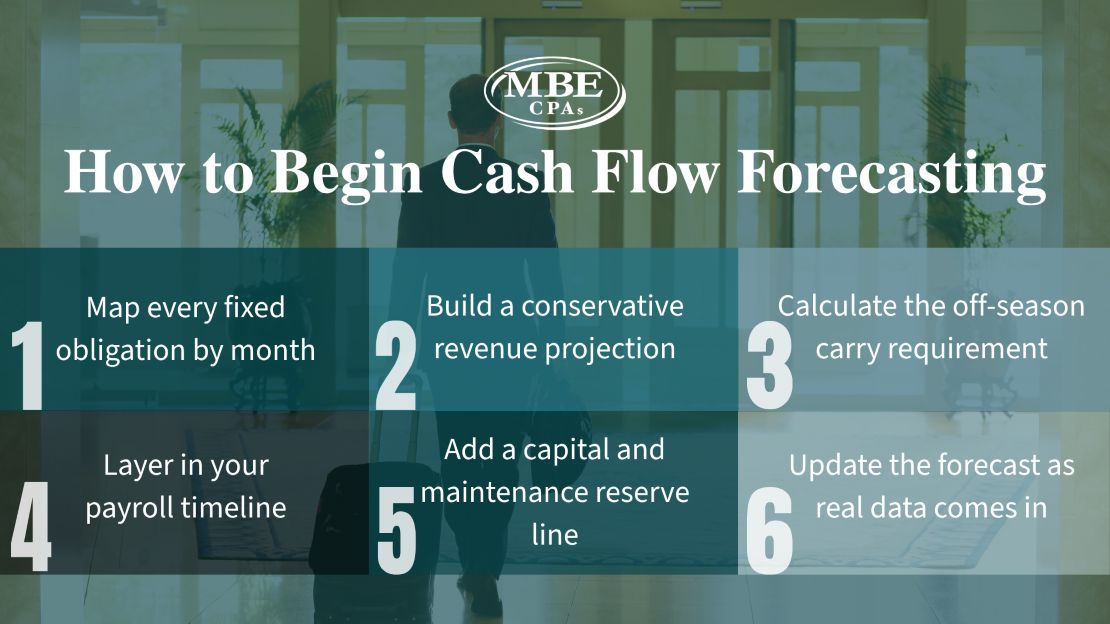
Cash flow forecasting sounds intimidating. The simple answer is that forecasting your cash movement comes from understanding your operating, investing, and financing activities. For seasonal lodging, it answers, “Do I have enough money now to cover what’s coming later?”
Here’s how to build that answer:
- Map every fixed obligation by month
- Build a conservative revenue projection
- Calculate the off-season carry requirement
- Layer in your payroll timeline
- Add a capital and maintenance reserve line
- Update the forecast as real data comes in
Prioritizing your daily operations starts with having enough liquidity on hand. Read more about cash flow management and how managing profitability helps you face any season with confidence.
Should You Work with an Accountant?
You’re managing the front desk until 2 am, dealing with housekeeping turnover, and focusing on the guest experience. Where does bookkeeping and cash flow forecasting fit into your schedule?
Start working with our team at MBE CPAs. We work with seasonal lodging operators who are tired of white knuckling the off-season. Our forecasting service is built for businesses with compressed revenue cycles, because a standard monthly budget doesn’t capture the timing risks you’re actually living with.
Integrate our cash flow forecasting services.
- Map your full-year obligation against projected seasonal revenue
- Save enough peak-season revenue for off-season carry
- Flag payroll timing risks before hiring season to determine your pre-open runway
- Update your forecast monthly as bookings firm up
- Give you the key metrics, then track and interpret them
If you’re heading into a new season without a clear picture of where your cash will be in month seven, let’s change that.