Activity-Based Costing for Manufacturing Profit Growth

Authored by: Brett Leibfried — Partner, CPA | Date Published: March 17, 2026
An advisor may have pulled back the curtain on Activity-Based Costing for you, explaining how it identified the true “drivers” of your expenses. But knowing this formula is only half of the story.
If you’ve ever wondered why your high-volume products are showing shrinking margins despite no change in labor, you might be haunted by traditional costing. We’re going to look at the aspects left out of the ABC textbook, and the hidden costs of saying “yes.”
How Traditional Costing Can Spiral
Traditional costing is easy and simple to implement. Overhead is allocated using a single, volume-based cost driver. If a product takes more labor hours to produce, it should proportionally have a higher share of overhead. Straightforward enough.
Today, that’s problematic.
Imagine this scenario for a parts manufacturer. They have two product lines:
- Line A: 10,000 standard widgets (runs like clockwork).
- Line B: 100 custom valves (requires constant engineering oversight and multiple setups a day).
Under traditional costing, the overhead of the engineering team and setup mechanics is spread across both lines based on total machine hours. But Line A uses more hours. Now the cost of the engineers who are fixing problems on Line B is absorbed.
What’s the result?
Line A looks expensive, so the prices are raised. Now, customers are leaving for a more affordable competitor. This means that the same overhead must be spread over fewer units, making them look even more expensive. You raise prices again. More customers leave.
This is how a manufacturing business begins to spiral. How do you solve this problem?
ABC acts as the saving grace, pinning those engineering costs where they belong and protecting the competitive pricing of your high-volume winners.
Could Your “Best” Customers Be Your Least Profitable?
One aspect often left out of costing lessons is the Cost to Serve. Most manufacturers account for what happens on the floor, but ABC looks at the front office, too.
Consider two customers buying the exact same part at the exact same price:
- Customer 1: Pays on time and never changes a deadline.
- Customer 2: Frequent calls to the floor manager, requests tweaks mid-production, and wants expedited shipping.
From a traditional perspective, these customers are equally profitable. From an ABC perspective, Customer 2 is likely costing you more.
By identifying “order processing” and “technical support” as distinct cost pools, you realize that your most loyal customer might actually be a net loss.
This is why customer profitability analysis is one of the most powerful, underutilized applications of ABC in manufacturing.
Are Your Standard Products Funding Your Custom Work?
Every time you say “yes” to a new customer request or a new product variant, you’re accepting a hidden tax. With ABC, that tax becomes visible.
Think about these complexities like loose change. Finding a penny or a dime might not seem like much, and each one has little value on its own. But over time, the more you collect, the larger your hidden wallet fund becomes.
Each slightly different requirement or custom color might seem minimal when added to your cost structure one by one. But over time, these layers aren’t reflected in your pricing.
Consider these complex costs in a manufacturing environment:
- Setup and changeover time: Each new variant that requires a machine reset, a tooling change, or a line reconfiguration pulls capacity away from your standard.
- Procurement complexity: A product that requires three unique raw materials instead of two may be two or three times harder to manage when you factor in lead times, minimum order quantities, and the administrative work.
- Quality control: Standard products with established inspection protocols move through quickly, but custom products require hands-on inspection, more documentation, or more rework.
This is where ABC offers significant benefits.
These costs are assigned where they actually occur. Still spreading costs across your entire product line? You’re skewing your data to be more favorable when it’s not.
Eliminating complexity isn’t the goal, because it can still be genuinely profitable. Some of it is necessary, and some of it is genuinely profitable. ABC shifts the “blanketed” “profitability” toward subsidizing the margins earned by your most efficient products.
Learn more about discovering true product profitability.
Using Activity-Based Costing to Make Hard Calls
Now, the value that is derived from ABC is how you implement the information. Filling out a spreadsheet with cost driver information is valuable, but not if it sits untouched in your files. Learning a new method doesn’t stick until you practice, so let’s start practicing.
Understanding the true costs of producing and serving each product equips you with decision drivers, far more than vague margin reports would.
Here’s what implementation looks like:
- Confident pricing: When a customer pushes back on a price increase, you can point to the specific activities driving their cost.
- Rational product lines: Some products are introduced out of habit, rather than profitability. Now you can see which ones are dragging down your margins.
- Redirected capacity: Knowing which products are profitable helps you make capacity decisions that compound over time.
- Supplier negotiations: Protect supply reliability for the inputs and raw materials that matter most to your profitability.
Taking these next steps can’t all be done in one day, which is why manufacturers abandon their improved costing efforts. You don’t have to figure out the best method on your own. Consider partnering with a manufacturing advisor to lessen the weight of these decisions.
What Should Manufacturers Do Next?
Whether the ABC method is right for your business or not, this process is still a lens that focuses on the true costs of your operations. Start tapping into sharper data. Begin tightening your processes.
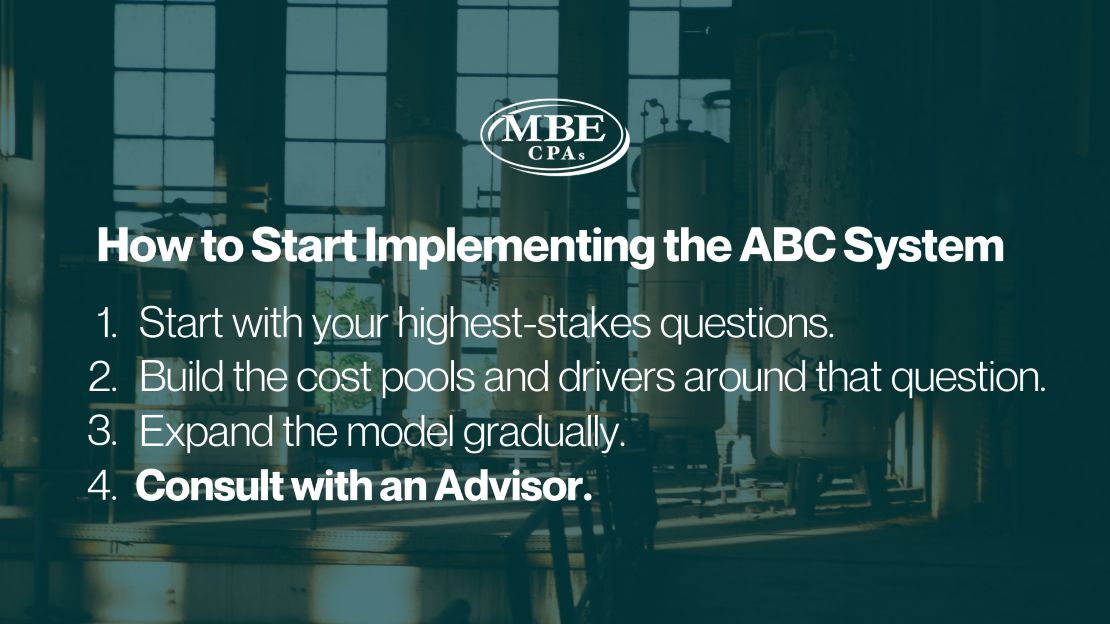
- Start with your highest-stakes questions. Which product line do you suspect is underpriced? Which customer relationship are you quietly uncertain about?
- Build the cost pools and drivers around that question. Explore the insights that change how you think about your entire business.
- Expand the model gradually. Add cost pools, refine driver assignments, and integrate ABC data into your regular pricing and capacity reviews.
- Consult with an Advisor.
We’ve covered how ABC works. Now we’ve shared what ABC reveals when you’re willing to look closely. Next, we’ll help you understand what your products and customers are costing you.
At MBE CPA’s, we provide manufacturers with accurate data to make those hard calls. Your manufacturing business does not fit into any one model, and with our support, you can grow and adapt your structure.