
What ADR and RevPAR Really Mean

Authored by: Greg Patel — Partner, CPA | Date Published: April 2, 2026
Your profitability surges through the different seasons, and that can’t be controlled, right? We can tell you one thing: While you may not be able to control seasonality, you can predict it. Understanding the critical hotel performance metrics helps owners make smarter pricing and staffing decisions.
You provide exceptional service to your guests. Let’s make sure your financial records reflect that.
Featured Topics:
The Importance of Understanding Average Daily Rate
On any given day, revenue from an occupied room is one of the industry’s most important key performance indicators. This is the average daily rate, or ADR. Knowing how effectively you’re using your space and profiting from it is what keeps your doors open and your rooms slept in.
What does ADR show?
The higher the ADR, the better. A rising ADR means you’re earning more from the rooms you do sell, a clear signal that your pricing is aligned with what the market will bear. Hotels should be looking for ways to increase the price per room without sacrificing the guest experience.
One of the best ways to do this is by focusing on pricing strategies. This can include:
- Dynamic pricing: Adjust room rates in real time based on demand, local events, or competitor pricing.
- Upselling at booking and check-in: Offer room upgrades, early check-in, or late check-out to increase per-room revenue.
- Cross-sell packages: Bundle amenities like dining credits, parking, or spa access.
- Complimentary offers: Justify premium pricing with perks like welcome amenities or a food and beverage credit.
- Segment your pricing: Adjust how you set your rates for corporate accounts, leisure travelers, or group bookings.
While the economy plays a huge role in setting prices, hotels need to match current demand and shake up their offerings to keep guests strolling into the lobby. Hotels that grow ADR consistently are the ones actively managing what they can control.
Learn about how other businesses have engineered their offerings to improve profitability.
Growing ADR isn’t simply about raising prices. The actual value of each stay is what matters the most.
What Does RevPAR Reveal About Your Hotel?
Have you ever asked yourself, “Am I capturing my fair share of the available revenue in my segment?”
You may understand how much you earn each time a guest checks into your hotel. But what about your ability to fill your available rooms?
RevPAR (revenue per available room) uses a wider lens than ADR to capture the performance of your entire inventory, rather than measuring only what occupied rooms earn. This metric holds you accountable for unsold inventory.
What does that mean?
A hotel with a high ADR and empty rooms may have a lower RevPAR than a competitor that charges less per room but maintains strong occupancy. This makes this metric one of the best tools for benchmarking your property against competitors in your market.
How is RevPAR Tied to ADR?
When your RevPAR increases, your occupancy rate improves. But many hotel owners mistake this distinction for better performance, which is not always the case. Many key factors are left out of the equation, which skews your overall performance.
This is where ADR becomes important. This metric is essential when calculating RevPAR to show per-room income, rather than just how well rooms are filled. Many hotel managers prefer to use ADR. With accurately priced rooms, both the occupancy rate and RevPAR should increase.
Consider a popular hotel in a frequently traveled-to area.
During peak season, weekend occupancy regularly hits 95%, and ADR climbs to $320. RevPAR is strong at $304. However, on weekday nights during the same period, occupancy drops to 50%, ADR falls to $210, and RevPAR declines to $109.
An owner can ask these questions now that they have access to this information:
- Can weekday occupancy be improved with mid-week packages?
- Is dropping the weekday night rate necessary or are guests booking last-minute regardless of price?
- Should staffing be scaled back on low-occupancy nights to protect margins?
Balancing your business’s finances starts with understanding seasonal cash flow. This analysis is where ADR and RevPAR move from metrics to tools, helping hoteliers drive real decisions about pricing, staffing, and channel strategy.
The Key Trade-Offs Between RevPAR and ADR
No metric tells the full story, and ADR and RevPAR are no exceptions. ADR can provide a more accurate RevPAR picture, and RevPAR offers a better assessment of competitive performance.
When to use each metric:
- Use ADR to evaluate pricing strategy and rate management decisions.
- Use RevPAR when benchmarking overall performance against competitors.
- Use both together to understand whether you’re optimizing revenue across your full inventory.
Knowing when to use each tool is helpful in making informed decisions. It’s also important to know your blind spots.
Here’s an honest look at where each tool falls short:
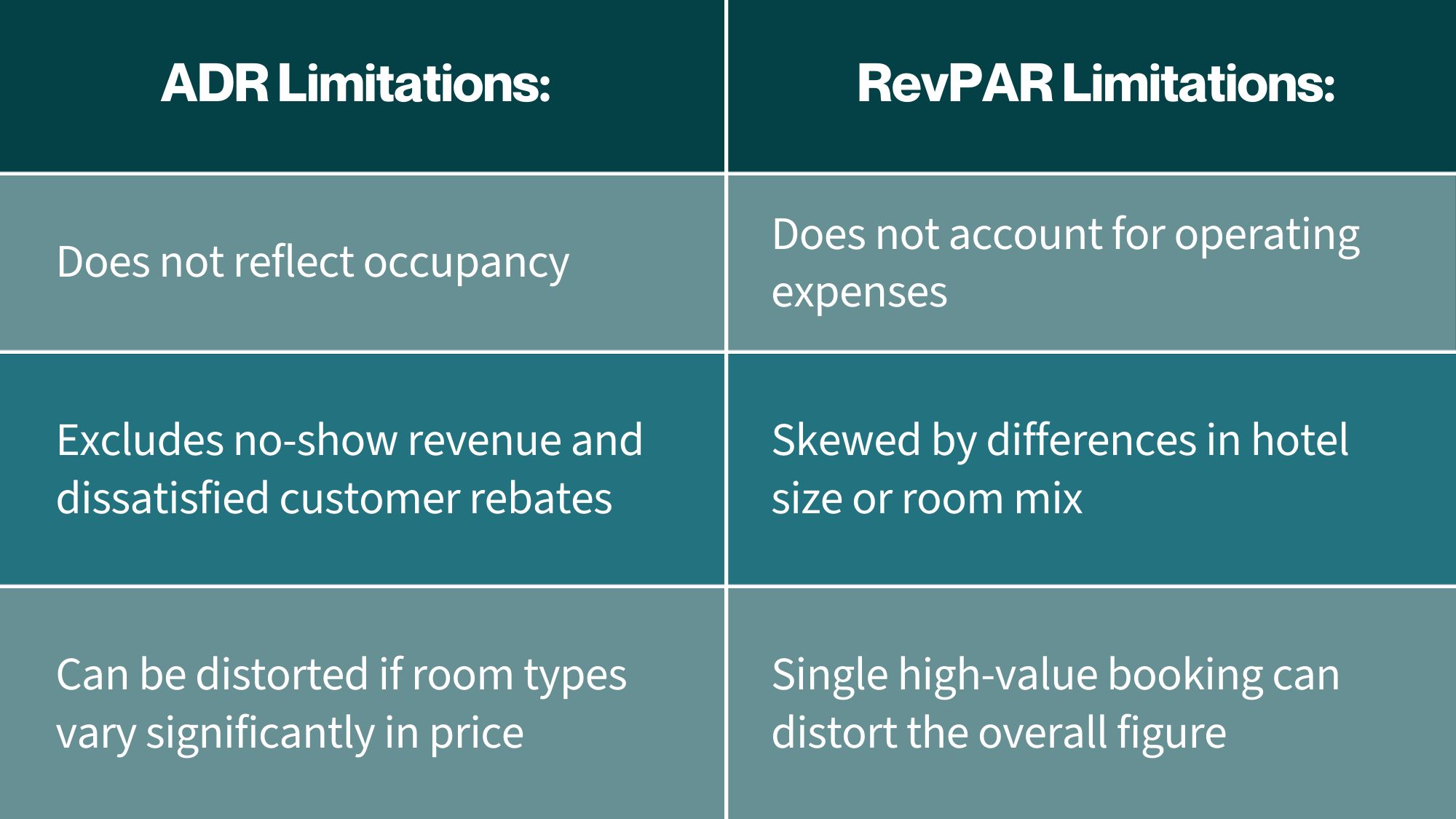
ADR does not include no-show charges or rebates offered to dissatisfied customers and can be skewed by occupancy rates. RevPAR focuses only on revenue, missing context on room size, mix, and quality.
The most successful hoteliers don’t rely on just one isolated metric. Building a dashboard to include ADR, RevPAR, occupancy rate, and other KPIs will develop a complete picture of performance.
What Other Factors Should Hoteliers Track?
Whether you’re analyzing trends, building a seasonal pricing model, or trying to understand why a strong occupancy didn’t translate to strong profits, having context will help clarify your data.
As you incorporate ADR and RevPAR into your regular financial review, keep these factors close at hand:
- Demand Forecasting: Work with an accounting team to model seasonal demand curves. Price proactively based on your peak windows.
- Channel Mix: Bookings from travel agencies typically come with higher commission costs. Tracking ADR by channel helps capture your true net revenue.
- Room-Level Performance: Track which room types, floors, or views are driving premium rates and which are underperforming.
- Competitor Benchmarking: Compare ADR and RevPAR against your competitive set. If your RevPAR index is below 100, you’re underperforming.
At MBE CPAs, we work with hospitality owners and operators who want more than just compliant books. Access to financial intelligence will help you make better decisions year-round, and our team is experienced in doing so.
We help you stay confident and prepared with the following support services:
- Review your ADR and RevPAR trends
- Identify missed revenue opportunities and help you reach growth goals
- Proactive tax planning to help you keep more of what you earn
- Manage cash flow forecast to sustain seasonal operations
- Handle daily financial transactions and keep your books up to date.
Reach out to a team that builds partnerships with a guest focus.