Audiology practice owners wear every hat, from clinician and HR manager to business owner, accountant, etc. When tax season rolls around, it can feel like just one more thing competing for your attention. But the truth is, the decisions you make around your finances don’t just affect your tax bill, they affect your practice’s ability to grow, hire, invest in better equipment, and serve more patients.
This guide is designed to help audiology practice owners get ahead of tax filing season. Whether you’re a solo practitioner or manage a multi-location clinic, these strategies will help you capture every deduction you’re entitled to, keep clean books your CPA will love, and help you make smarter financial decisions year-round.
What is Your Year-Round Financial Mindset?
After working with audiology practice owners for years, the pattern is hard to miss. The ones who end up with painful tax bills almost always treated taxes as a once-a-year problem. The practices that consistently keep more of what they earn are not doing anything magical. They are just organized, proactive, and stay in close contact with their advisor all year long. Good tax outcomes are built month by month. That is not a theory, it is just what I have seen.
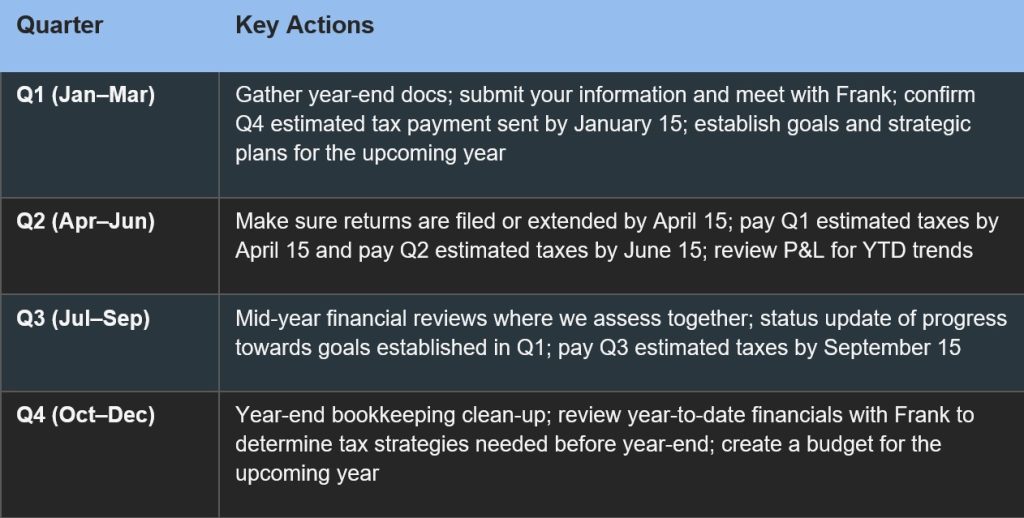
Think of your financial calendar in quarters. Each quarter presents specific opportunities to minimize tax liability, stay compliant, and make informed business decisions. When you build these habits into your routine, filing your taxes becomes far less stressful and far more strategic.
The Quarterly Tax Calendar for Audiology Practices
Here’s what you should be doing each quarter to stay ready year-round:
Are You Prepared for Your Estimated Tax Payments?
If you’re a self-employed owner, you’re responsible for paying taxes throughout the year, not just at filing time. The IRS requires quarterly estimated tax payments if you expect to owe $1,000 or more in federal taxes for the year.
Proactive tax planning before paying estimated tax payments is one area where I often help audiology practice owners. Missing or underpaying quarterly taxes can lead to penalties, even if the full amount is paid when you file.
By projecting your current year income together, I can help determine the right quarterly payment amounts and make sure those deadlines are built into your financial calendar so nothing slips through the cracks.
What Monthly Bookkeeping Habits Should Audiologists Follow?
The state of your books in December is a direct reflection of the habits you’ve built all year. Here are the monthly practices that make the biggest difference:
- Reconcile all bank and credit card accounts against your statements every month, don’t wait until year-end.
- Categorize every transaction properly in your accounting software as it occurs, not in a panic in April.
- Keep personal and business finances separate. If you haven’t set up a dedicated business checking account and credit card, do it now.
- Log business mileage in real time using an app like MileIQ or a dedicated mileage log. Reconstructing mileage at year-end is both inaccurate and time-consuming.
- Store digital copies of all receipts. Most modern accounting tools allow photo uploads directly from your phone.
A clean set of books doesn’t just make tax prep easier, it gives you accurate, real-time insight into how your practice is performing financially. Remember Ben Franklin’s famous quote, “Failing to prepare is preparing to fail”.
What Should I Prepare Before It’s Time to File My Taxes?
One thing I’ve learned from working with audiology practices is that the tax process runs much more smoothly when the right documentation is organized ahead of time. The guidance I can provide is only as effective as the information we’re working with.
If you’ve been keeping up with your bookkeeping throughout the year, most of what we need will already be in place. In order to submit your tax documents for filing, I typically recommend gathering the following items:
- Profit & Loss statement (year-to-date)
- Balance sheet
- Payroll records and W-2/1099s for all staff
- Bank and credit card statements reconciled through December
- List of new assets purchased, including purchase documents
- Loan statements (including equipment financing)
- Mileage logs if you used a personal vehicle for business
Providing these materials proactively, rather than in response to repeated requests, allows your CPA to focus on strategy and savings rather than chasing paperwork.
Most Missed Deductions in Hearing Care Practices
Many audiology practice owners leave money on the table every year. Because each practice owner’s tax situation is different. The tax strategies used are different for each taxpayer. You need to make sure that you are working with a competent CPA who knows your industry well to maximize tax savings.
Is Your Retirement Plan Missing a Key Tax Strategy?
For audiology practice owners, retirement accounts are one of the most powerful tools available for reducing taxable income. Depending on your practice structure, you may be eligible to contribute significantly more than the standard IRA limit:
- SEP-IRA: Allows contributions up to 25% of net self-employment income, with a 2026 limit of $72,000.
- Solo 401(k): Ideal for sole proprietors and single-owner S-corps, with combined employee/employer contributions up to $24,500 in 2026 (plus an $8,000 catch-up if you’re 50+).
- SIMPLE IRA: A good option if you have employees, with lower administrative burden than a 401(k) gives you the option to contribute up to $17,000 (plus a $4,000 catch-up if you’re 50+).
Contributions to these plans are deductible in the year they’re made, directly reducing your taxable income. Work with your CPA to determine which plan type fits your practice structure and cash flow.
Are You Set Up the Right Way?
Your practice’s legal and tax structure can have a major impact on how much you pay in taxes each year. I often see solo and small-group audiologists operating as sole proprietors or single-member LLCs when an S-corporation election might save them thousands annually in self-employment taxes.
There isn’t a one-size-fits-all answer. The right structure depends on factors like your net income, growth plans, and overall risk profile. But if we haven’t reviewed your entity structure together in the last couple of years, it may be time to revisit it.
Even small structural adjustments can lead to meaningful tax savings year after year, and it’s something I’m always happy to help my clients evaluate.
Working with Your CPA Year-Round
I don’t believe your relationship with your CPA should begin in February and end in April. I encourage my clients to schedule mid-year or quarterly check-ins so we can review your financials, revisit estimated tax payments and talk through any major decisions you may be considering, like new hires, equipment purchases, or expansion plans. Even a short conversation can help prevent costly surprises at filing time.
My goal is to work alongside you throughout the year. When we build consistent habits together, like staying on top of monthly bookkeeping, quarterly payments, and proactive planning, tax season becomes just another item on the calendar instead of a stressful deadline.
You work hard to run your practice all year. I want to make sure your tax strategy is working just as hard for you.
Ready to build a more financially resilient practice?