
How Trusted Tip Tracking Supports Restaurant Growth
Authored by: Doug Gross — Partner, CPA, CPGMA | Date Published: March 3, 2026
Running a restaurant means balancing the high energy of the kitchen with the precision of the back office. For many owners, the vast amount of paperwork required to track gratuities feels like a second job.
No matter what type of restaurant you run, from a busy breakfast cafe where customers tip at the counter to a white-tablecloth establishment with career servers, the challenge remains the same. Keeping up with changing tax laws while making sure every dollar is accounted for. Using restaurant payroll tip tools, such as a tip log, can help accurately track and report tips.
The truth is, tip reporting and compliance aren’t only about avoiding penalties. Done right, it’s an opportunity to recover funds, support your team, and build a stronger financial foundation for your business. Here’s what you need to know.
How Can Restaurants Recover Payroll Taxes Paid on Tips?
Many restaurant owners are unaware that they can recover some of the payroll taxes paid on employee tips. The Federal Insurance Contributions Act or FICA Tip Credit is a special tax benefit that allows you to decrease your federal income tax by the amount you pay in employer Social Security and Medicare taxes. These taxes are 7.65% of certain employee tips.
For example, imagine a server who works 100 hours in a month and earns $2.83 per hour in direct wages. Over that month, the server reports $2,200 in tips. After accounting for the federal minimum wage threshold of $5.15 per hour, you can claim a credit of about $1,685 of tip income. At 7.65%, that’s roughly $129 per employee each month. Multiply that by your whole staff over a year, and you could receive thousands of dollars in tax savings.
To qualify for the FICA Tip Credit, you must run a food or beverage business where tipping is common, your employees need to receive tips directly from customers, and you must have paid employer Social Security and Medicare taxes on those reported tips during the tax year. The credit cannot be claimed for taxes on tips used to meet the $7.25 federal minimum wage.
Important notes:
- Service charges or mandatory gratuities do not count toward this credit.
- Recent legislation has expanded the FICA Tip Credit to include personal care services such as salons and spas.
- Claim this credit by filing IRS Form 8846 with your annual tax return.
- Unused credits can be carried back for 1 year or carried forward for up to 20 years.
Do You Need to File Annual Tip Income Reports for Compliance?
If you operate a restaurant or bar with tipped employees, you may need to fill out IRS Form 8027 each year if you answer yes to all of the following criteria: Your establishment provides food or beverages for on-premises consumption (not primarily fast food or takeout), tipping is customary, and you normally employ more than 10 employees on a typical business day during the previous calendar year.
To determine the 10-employee requirement, calculate total hours worked by all staff during a representative period and divide by the number of days. For example, if your team worked 2,950 hours over 31 days, that’s 95 hours per day. Divided into 8-hour shifts, you’d have more than 10 employees and would need to file.
Paper tax returns are due in early March, while electronic returns have a later March deadline. If you file 10 or more tax forms during the year, you must file Form 8027 online through the IRS electronic submission system. You’ll need a Transmitter Control Code (TCC), which can take up to six weeks to get.
What gets reported on Form 8027:
- Total gross receipts for food and beverage sales
- Total charged receipts (credit card sales)
- Total charged tips shown on those receipts
- Total tips reported by employees
The IRS uses an 8% benchmark. If reported tips are less than 8% of your gross receipts, you may need to allocate the difference among your tipped employees and report these allocated tips on their W-2 forms.

What Are the Current Tip Pooling Rules for Restaurants?
Tip pooling can be a fair way to distribute gratuities among your team, but the rules are specific and getting them wrong can lead to violations and penalties.
Basic tip pooling rules under federal law:
- Tip pooling is permitted when tips are shared among employees who customarily receive tips.
- Managers, supervisors, and owners cannot participate in tip pools if they claim a tip credit.
- If you pay all employees the full minimum wage, you can include back-of-house employees in tip pools.
- Employees must be informed about tip pooling arrangements.
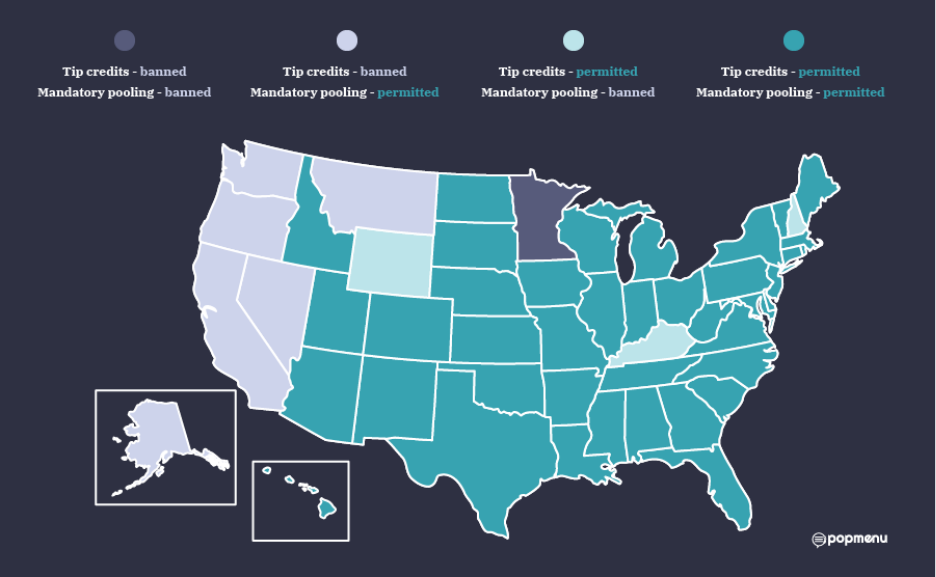
Tip pooling rules differ by state. In Colorado, employers must notify customers if tip pools are mandatory, and any employee earning more than $1.64 per hour in tips can participate. Wisconsin allows required tip pooling and includes back-of-house staff if everyone is paid at least minimum wage, but managers and supervisors are never part of the pool. Arizona permits tip pooling among front-of-house staff, but non-tipped employees cannot be included when a tip credit is used.
Best practices for tip pooling compliance:
- Document your tip pooling policy in writing.
- Communicate the policy to all employees.
- Track which employees are eligible to participate.
- Maintain complete records of how tips are collected and distributed.
- Use automated payroll systems to reduce errors.
What Are the Latest Restaurant Tax Regulations for Tips and Overtime?
Recent federal legislation under the One Big Beautiful Bill Act (OBBBA) created a temporary tax deduction for qualified tips and overtime compensation through 2028. While this benefit goes to employees, restaurant owners have new reporting responsibilities.
Here’s how it works:
- Employees in tipped occupations can deduct up to $25,000 of qualified tip income annually on their federal tax returns.
- Only voluntary customer tips qualify, not mandatory service charges.
- The IRS lists 68 jobs that qualify, with food service workers among the most common.
- The deduction gradually decreases for workers who earn more than $150,000 a year. For joint filers, this limit is $300,000.
Last year, the IRS provided transition relief. However, starting this year, you must report the total amount of cash tips separately on Form W-2, include the employee’s job title using new Treasury codes, and clearly separate tips from service charges in your records. If you are wondering, “Do you have to report cash tips?” the answer is yes, and noncompliance could trigger penalties of $60 to $680 per incomplete form.
Action steps for restaurant owners:
- Review your point-of-sale and payroll systems to separate tips when applicable.
- Identify which job titles count as tipped positions.
- Update receipts and contracts to clearly label service charges as wages.
- Communicate these changes to your team.
How Can Payroll Systems Support Accurate Tip Reporting for Restaurants?
Managing tip reporting, FICA credits, Form 8027 filings, and tip pooling manually is time-consuming and error prone. Using restaurant compliance software for tip reporting can simplify these processes and reduce errors. Our Payroll Solutions team handles the IRS reporting requirements, including special rules for tips and overtime pay. Our tools connect with most accounting software, so you only have to enter your numbers once.
Benefits of integrated payroll solutions for handling tips and gratuities in payroll reports:
- Automatic calculation of FICA taxes on tips
- Proper separation of tips versus service charges
- Immediate tracking for Form 8027 reporting
- Digital tip distribution with full transparency
- Automatic generation of required tax forms with new occupation codes
What Action Steps Should You Consider?
Now that you understand the key areas of tip reporting and compliance, it’s time to put this knowledge into action. Start with the areas that will have the biggest impact on your business.
Here’s your practical roadmap:
- Review your current systems – Can you track tips separately when applicable and identify which employees qualify for tip credits?
- Calculate your potential FICA Tip Credit – Look at your reported tips and payroll taxes. You might be missing significant money.
- Determine if you need to file Form 8027 – Run the employee calculation and start your TCC application if needed.
- Document your tip pooling policy – Make sure your current practices comply with federal and state law.
- Connect with professionals who understand restaurants – The right accounting and payroll partners can save you time, money, and stress.
What Should You Do Next?
Tip reporting and compliance doesn’t need to be overwhelming. At MBE CPAs, we believe that growing a successful restaurant business takes more than just great food and service. It takes a team that understands the details, supports your goals, and helps you make the most of every opportunity.
Let MBE CPAs take the burden of compliance off your shoulders, so you can pour your energy into your team and your guests. If you’re ready to strengthen your restaurant’s foundation and keep your business moving forward, contact MBE CPAs. Together, we’ll help you achieve long-lasting success.