Master Your Sole Proprietor Taxes

Authored by: Diane Payne — Partner, EA | Date Published: December 4, 2025
You’ve made it this far by starting your business and running it solely on your own. Whether you’ve reached the point of smooth sailing operations or are still working out some kinks, there is always room for improvement, especially when it comes to taxes.
Since you’re personally liable for all business debts and obligations, we’re here to help you mitigate as much as possible. It’s time to truly take advantage of your “complete control” business structure and manage your taxes with ease.
Are you ready to master your approach to tax season?
Featured Topics:
How Do Sole Proprietor Taxes Differ?
Sole proprietorships are considered the simplest business structure. As a business owner, you have complete control over your business because it’s owned and run by you alone. For all aspiring entrepreneurs, this sounds ideal.
However, many business owners forget that they are personally responsible for all business debts, liabilities, and lawsuits.
What does this mean for taxes?
As a sole proprietor, you are responsible for paying federal income tax and self-employment tax on your business profits. These are called “pass-through” taxes, where business profits are taxed to your personal tax return at your individual income tax rate that varies depending on your income bracket.
Think of it this way
A freelance sole proprietor’s earnings flow directly into their Form 1040, and they don’t have withheld taxes from each paycheck. Instead, they’re responsible for both the employer and employee portions of payroll taxes, as well as an additional income tax liability.
Here are other important considerations:
- Quarterly Payments: The IRS requires you to make estimated tax payments on your expected income for the current year since no employer is withholding taxes for you.
- Business Expense Deductions: You can reduce your taxable income by deducting “ordinary and necessary” business expenses. Common deductions include home office expenses, business mileage, health insurance premiums, and the Qualified Business Income deduction.
- Record-Keeping: Sole proprietorship returns may face higher IRS scrutiny, so it is important to keep detailed records of all income and expenses to remain compliant.
- Owner’s Draw: Taking money out of your business for personal use, an owner’s draw, is not a tax-deductible salary. You are still taxed on the business’s entire net profit, regardless of how much you withdraw.
Remember, having complete control of your business means relying entirely on yourself for all important business functions. Implementing strong business practices will help you maintain a consistent tax preparation process.
If you find yourself struggling to keep up with your business’s bookkeeping, consider outsourcing to a reliable partner.
New Tax Law Changes
The One Big Beautiful Bill permanently extends tax cuts from the Tax Cuts and Jobs Act, making the tax law more complex for sole proprietors.
These tax changes include:
- Increased SALT deduction cap: This is an opportunity for eligible self-employed workers to write off more state and local tax payments on their federal returns if they itemize deductions.
- Energy credit reductions: Cuts to energy credits passed under the Inflation Reduction Act.
- Taxes on tips and overtime: Although temporary, this deduction allows eligible tipped workers, including self-employed workers, to write off up to $25,000 in tips.
- Reforming Medicaid: After December 31, 2025, the new limitation provision capping the value of each dollar of allowable itemized deductions at 35 cents does not exclude medical, investment interest, and casualty and theft deductions from application of the limit.
- 2026 enhancement: Starting in 2026, there’s a new minimum pass-through deduction. If you have at least $1,000 in qualified business income, your deduction must be at least $400, even if the standard 20% calculation would result in less.
- Increased debt ceiling. Eligible sole proprietors can continue deducting up to 20% of their QBI and immediately expense the full cost of many new business assets.
- FAFSA simplification. Sole proprietors will have an easier time qualifying for need-based aid like Pell Grants because the value of the business will no longer need to be disclosed on the FAFSA form.
When filing your taxes this upcoming season, make sure you’re taking advantage of all deductions you’re eligible for as a sole proprietor.
Not confident in your filing abilities? Contact MBE CPAs for tax filing aid.
Best Practices for Tracking Business Expenses
When was the last time you updated your books? You’ve been so focused on business development that you might be falling behind on this core task.
Maintaining detailed records for all ordinary business costs will help you effectively track expenses and claim all eligible deductions on Form 1040 Schedule C.
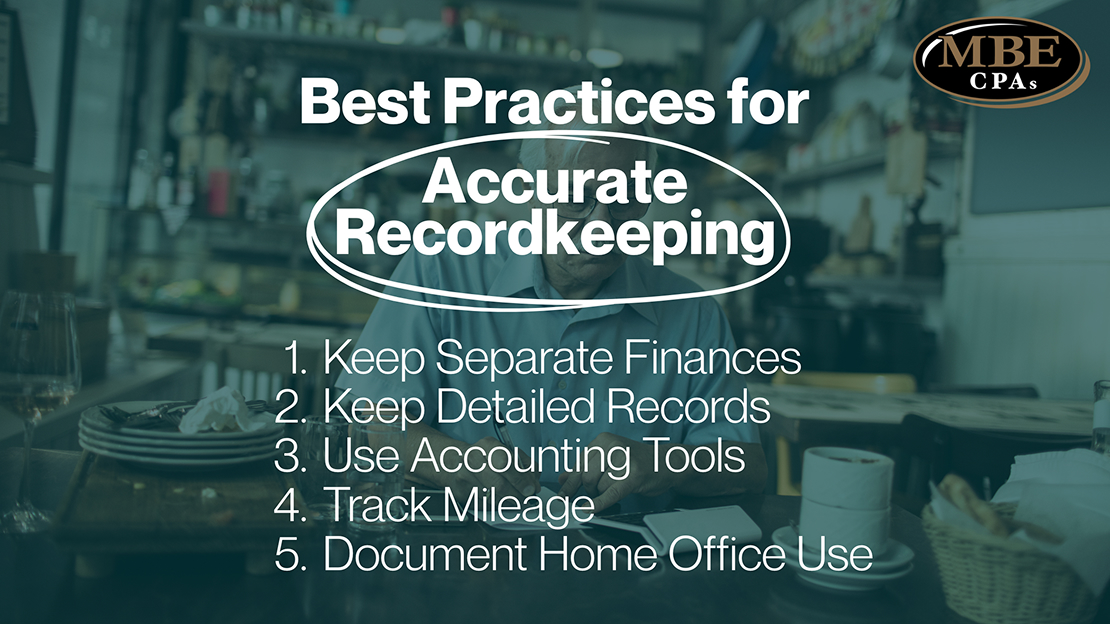
Here are some best practices for your recordkeeping:
- Keep Separate Finances: Your personal and business expenses should be kept in separate bank accounts, and you should use dedicated business credit cards to simplify tracking.
- Keep Detailed Records: For every business expense, document the date, amount, purpose, and category. Original receipts are best, but detailed logs are also acceptable.
- Use Accounting Tools: To make tax preparation easier, utilize accounting software or a simple spreadsheet to log and categorize expenses regularly.
- Track Mileage: If you use a vehicle for business, keep a detailed mileage log noting all trip dates, mileage, destinations, and purposes. In the first year of using that car, you can decide whether to deduct expenses using the standard mileage rate or the actual expenses method.
- Document Home Office Use: If you work from home, you must meet the “regular and exclusive” use test to qualify for the home office deduction. Maintain records of home-related expenses like rent, mortgage, utilities, and insurance.
Running a business is time-consuming, so finding ways to be as efficient as possible will help your performance continue to reach new heights. Preparing for tax season is the first step.
Key Takeaways for the Upcoming Tax Season
While becoming a sole proprietor offers certain freedoms, it also entails additional responsibilities.
Here are the main takeaways to keep in mind this upcoming tax season:
- You can deduct qualifying health insurance costs for yourself, your spouse, and any dependents as an “above-the-line” deduction.
- You can deduct ordinary and necessary business expenses.
- You are responsible for self-employment taxes, which are both the employer and employee portions of Social Security and Medicare taxes.
- The IRS expects accurate business records to support your deductions.
You don’t have to navigate through these tax changes alone. Professional tax help isn’t just another expense, but an investment that typically pays for itself through tax savings and peace of mind.
At MBE CPAs, our team dives into the unique complexities your business will face to help maximize your total return. Your main concern should be your business, not the accuracy of your books – leave that to our advisors.