Most hotel owners think of sustainability as a cost center. The IRS sees it differently. Upgrading your HVAC system, opting for LED lights, and installing smart energy systems won’t just bring down your energy bills.
These upgrades qualify for federal tax deductions that could be worth hundreds of thousands of dollars for your property. But only if you act before the deadline.
What Tax Provision Should Every Hotel Owner Know?
There is a section of the tax code doing the heavy lifting here. You may have heard of it in passing, but most hotel operators don’t realize just how powerful it can be when applied to a hospitality property.
We’ve broken it down for you:
Section 179D – Energy Efficient Commercial Buildings
Section 179D is the federal deduction for energy-efficient commercial buildings. Hotels qualify when they install qualified improvements, such as interior lighting.
You can claim a deduction of up to $5.00 or more per square foot of your building.
For a 120,000 sq. ft. full-service hotel, that’s potentially $600,000 in direct deductions.
The deduction scales by how much your property reduces energy use compared to a baseline standard. Larger reductions? Larger deductions.
Remember, tax planning should be proactive, not reactive. Working with a qualified energy modeler to certify those numbers is the kind of thing you and your accountant should be coordinating right now.
If you’ve been thinking about capital improvements to your property, the window to maximize your tax benefit is open, but only for a short time.
When’s the Deadline to Apply for the Energy Efficient Deduction?
To qualify for the full $5.00+ per sq. ft. deduction, qualifying projects must commence construction by June 30, 2026.
“Commence” has a specific IRS meaning: You typically need physical work to begin and costs to be incurred. Don’t wait until June 29th.
How do I claim energy deductions for my hotel?
To claim Section 179D, here’s what you need:
- Documentation: Specifically, you need a qualified energy study performed by a licensed engineer, certifying that your property meets the required energy deduction thresholds.
- Records: You need to know where your energy baseline is. That means records. Utility bills. Sub-metering data. Energy management system logs.
Hotels that have been tracking energy costs by floor, by system, by season, will walk into this process with a major advantage. Throwing utility bills in a drawer? You’re likely starting from scratch, and that costs time and money.
What Do Hotels Actually Save From Sustainability Accounting?
When you think of cost-saving ideas for your hotel, you’re focusing on the obvious. Tighter labor schedules, better linen reuse programs, and renegotiating vendor contracts. Those matter, still. But the intersection of energy efficiency and tax strategy is where the numbers get genuinely dramatic.
Let’s look at a practical example:
A 95,000-square-foot independent hotel has aging interior lighting and utility bills that run above the industry average. The ownership group decides to upgrade to LED throughout, upgrading the fixtures in every room. The total project cost was $1.4 million.
However, this team planned ahead. With three years of utility data and by working with an energy modeling firm, they qualified for a $4.75-per-square-foot 179D. The net after-tax cost of the project was roughly half of what they paid out of pocket.
That’s what happens when green operations meet smart accounting.
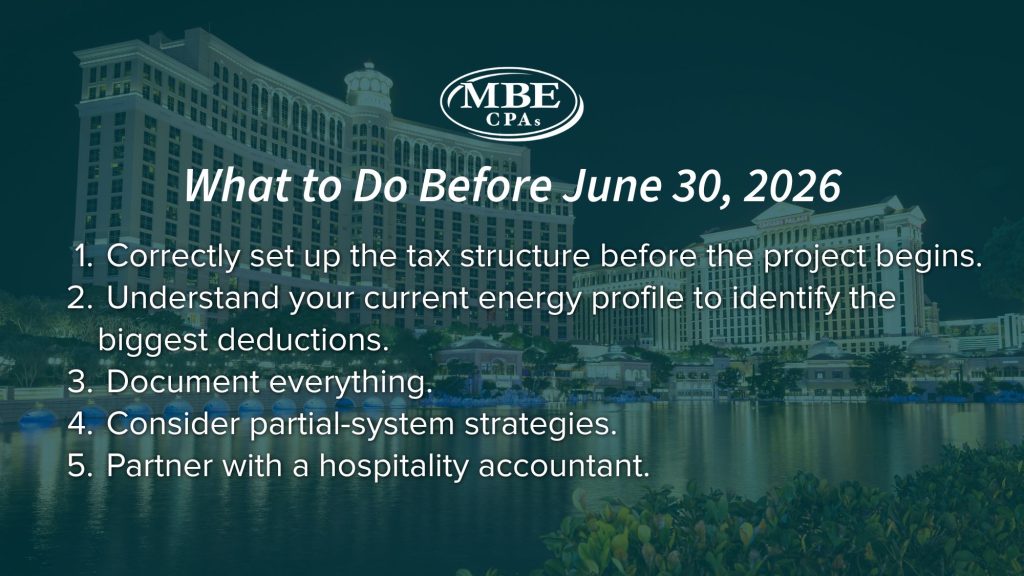
What to Do Before the Deduction Deadline
This deduction is deliberately designed for the investments your property has started to map out. But with the creeping deadline, the conversation about whether you invest in renovations needs to happen now, not someday. Keep the tax math in mind.
Here’s how to think about the next few months:
- Start with your accountant, not your contractor. The tax structure of a qualifying project needs to be set up correctly before the work begins. Don’t hand your hospitality accountant a completed project and ask them to figure out the tax implications.
- Get an energy baseline study now. Even if you haven’t decided which improvements to make, understanding your current energy profile tells you which systems will generate the biggest deductions.
- Document everything. The IRS requires that 179D deductions be supported by a certification from a qualified engineer using approved software.
- Consider partial-system strategies. You don’t have to flip your entire property to qualify. 179D allows partial deductions, such as lighting-only, when full building certification isn’t feasible.
Talk to a hospitality accountant who understands energy deductions before you break ground.
At MBE CPAs, our hospitality accounting team specializes in energy-efficiency tax strategies for hotel and lodging properties. Together, we’ll look at what your next capital project could actually cost when factoring in the tax benefits.
Make that call before the project starts, not after.