The ovens go on before the first customer walks in. The HVAC fights your kitchen heat all day. The dining room lights stay on through lunch, dinner, and every table turn in between. Running an independent pizzeria means running a building that never really rests, and that energy demand adds up fast, both on your utility bills and in the tax deductions.
A federal tax incentive built for high-energy commercial buildings like yours has already closed its door to new construction projects. It is called Section 179D, and understanding where that leaves you, whether your project began construction before the cutoff or you are considering other tax rules for equipment purchases, could make a difference in what you owe at the end of the year.
What Is the Section 179D Deduction and Why Should Pizzeria Owners Know About It?
Section 179D is a federal tax deduction for owners of commercial buildings that place qualifying energy efficient building property in service during the tax year. It covers three main areas of your building:
- Interior lighting systems
- Heating, ventilation, and air conditioning (HVAC)
- The building envelope, including insulation, windows, and exterior doors
To qualify, your improvements need to reduce your building’s annual energy costs by at least 25% compared to a standard reference point set by federal guidelines. The deduction grows as your energy savings grow, so more meaningful upgrades produce a larger deduction.
This applies to both new construction and renovation projects. If you began a remodel, footprint expansion, or system replacement before the required start date, you may already be on the path to qualifying. Projects that have not yet started construction no longer qualify under current law.
Why Do Pizzerias Qualify for This Deduction?
Restaurants are among the most energy-intensive commercial buildings in the country, and pizzerias sit near the top of that list. Foodservice buildings use roughly four times more energy per square foot than the average U.S. commercial building. Your deck or conveyor ovens run for 10 to 12 hours a day, your kitchen generates significant heat that your HVAC system fights against all day long, and your dining room lights stay on through every shift.
That kind of energy use is one reason restaurant buildings may be candidates for Section 179D when qualifying building systems are upgraded. Investing in improvements that bring those costs down may make your project eligible for a deduction at tax time.
The deduction applies to qualifying building property, not to ordinary kitchen equipment. That distinction matters for owners who expanded, renovated their dining room, or upgraded insulation as part of a larger build-out.
What Building Systems and Improvements Can Qualify?
The upgrades that qualify are likely the ones you have already thought about for practical reasons. Qualifying costs are generally tied to building systems, not to standalone kitchen appliances. Here is what can count toward it:
HVAC
- High-performance commercial HVAC units replacing older systems.
- Upgraded kitchen ventilation and exhaust hood systems.
- Programmable thermostats and energy management controls.
Lighting
- LED replacements for your dining room, bar, and restrooms.
- Occupancy sensors and dimming controls for less-used spaces.
- Full LED fixture replacements were done as part of a renovation.
Building Envelope
- Added or upgraded wall and roof insulation.
- Energy-saving windows and exterior doors.
- Building sealing improvements that reduce heating and cooling loss.
Because the deduction is based on overall energy performance, coordinating multiple system upgrades during a renovation simply offers a different starting point when analyzing eligibility than swapping a single piece of equipment.
How Much Can a Pizzeria Deduct?
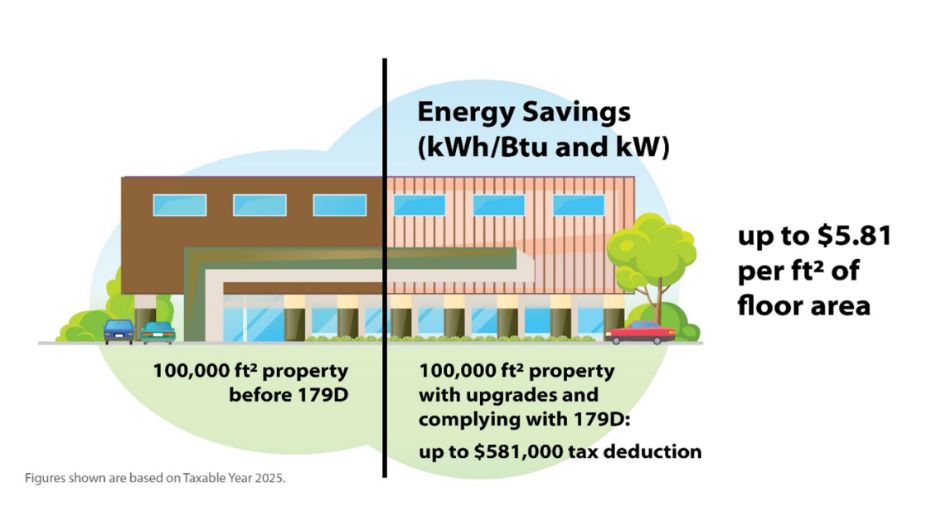
For tax years beginning in 2025, the deduction ranges from $0.58 to $5.81 per square foot of your building, depending on how much energy your improvements save and whether your project meets federal prevailing wage and apprenticeship requirements during construction.
Here is a simplified way to look at the ranges:
- Base rate (no wage requirements): $0.58 to $1.16 per square foot, scaling up with the percentage of energy savings achieved above the 25% threshold
- Higher rate (with prevailing wage compliance): $2.90 to $5.81 per square foot
To put those numbers in real practical terms for a pizzeria owner:
- A 2,500 sq. ft. location at $1.00/sq. ft. = $2,500 deduction
- A 4,000 sq. ft. location at $2.50/sq. ft. = $10,000 deduction
- A 6,000 sq. ft. location at $5.81/sq. ft. = $34,860 deduction
- Multiple locations multiply these numbers across your entire portfolio.
Can You Stack Section 179D With Other Tax Strategies?
Yes, and this is where working with a CPA who knows your industry pays off. The Section 179D energy efficiency tax deduction does not have to stand alone. It can be integrated into a broader tax strategy designed to evaluate how depreciation and deduction timing may apply in the year your project was completed.
Three strategies that work well together:
- Section 179D (Building Energy Efficiency): The deduction covered in this post applied to qualifying lighting, HVAC, and building envelope improvements before the deadline.
- Section 179 (Equipment Expensing): Separate rule that may apply to qualifying equipment purchases, such as certain ovens or refrigeration equipment, subject to its own limits and requirements.
- Cost Segregation: An engineering-based study that reclassifies components of your building, including flooring, counters, electrical, and plumbing, into shorter depreciation schedules, accelerating the deductions you take in early years.
These rules are separate and may apply to different categories of property, so the tax result depends on the facts and the property involved. This applies especially to owners who completed a new build or renovation before the cutoff, or who purchased a building.
Does Section 179D Work Differently for New Construction vs. an Existing Location?
Both paths qualify, and each has its own approach.
For new construction, claiming the deduction requires installing qualifying property within covered building systems, backed by a compliant, completed certification study. If that describes your project, you should confirm that the required certification and supporting records have been assembled. If you have not yet started construction on a new location, that project no longer qualifies for Section 179D.
For an existing pizzeria, the path forward is updating your current building in place rather than starting fresh. The IRS offers an alternative measurement pathway that evaluates actual improvements in energy use over time, rather than requiring upfront modeling projections. This pathway may apply to qualifying retrofit work, but prior-year claims depend on the placed-in-service year, the certification rules in effect for that year, and the accounting method procedures that apply.
For multi-location owners, each building is evaluated separately, so the deduction can be applied to qualifying improvements across your entire portfolio, one location at a time.
What Documentation Is Required to Claim This Deduction?
To support a Section 179D claim, a licensed engineer or architect must perform a third-party certification study to evaluate whether the property meets the necessary federal energy-savings thresholds.
The documentation process generally includes:
- An energy study performed by a qualified professional confirms that the required savings were achieved.
- A signed certification letter documenting those results.
- Construction records confirming what was installed, when, and where.
- IRS Form 7205 submitted with your tax return, or Form 3115 if you are claiming a prior project retroactively.
The earlier you bring your tax advisor into the conversation, the easier it is to evaluate your project’s eligibility and put together the supporting documentation.
When Does Section 179D Expire, and What Does That Mean for Your Business?
Current law terminates the deduction for property whose construction begins after June 30, 2026. A project did not need to be finished by that date, it needed to start, either through significant on-site physical work or by incurring at least 5% of total project costs under a signed contract. That distinction now determines where your business stands. That means:
- If you started construction before the cutoff, your project may still qualify even though the deadline has passed. Confirm the timeline with your CPA and gather your documentation.
- If you have not yet started construction on a new project, it no longer qualifies under current law, regardless of when you complete it.
- If your pizzeria has never claimed Section 179D for an earlier project, review with your tax advisor whether any prior-year procedure is still available under the rules that apply to that year.
Are You Capturing Every Tax Advantage Your Pizzeria Has Earned?
At MBE CPAs, we take the time to dig into the details with every client we work with. If your project began construction before July 1, 2026, or if you want to review whether an earlier project was handled correctly under the rules for its year, let’s connect.
Looking into energy-efficient operations is a great way to review potential utility adjustments and explore how these upgrades fit into your tax planning. Protecting that bottom line, though, goes beyond your utility costs. Are you sure you are capturing every dollar of the FICA tip credit? Many pizzeria owners we review are underclaiming the FICA tip credit