
Store grain when the market pays you to hold it, and treat the tax timing as a second benefit, not the main reason. For cash-basis farmers, unsold grain in the bin isn’t income yet, so storage can move revenue into a lower-income year. But that deferral only pays off if carry, basis improvement, and price outlook cover your storage costs and risk.
In this article, you’ll learn how to run the storage math, how cash vs. accrual accounting changes what storage does to your tax bill, how deferred payment contracts, basis contracts, and hedges are taxed, and how CCC marketing loans fit in. We’ll finish with a checklist you can use before year-end.
Does storing grain pay off after storage costs?
By the Numbers
USDA estimated U.S. on-farm storage capacity at 13.63 billion bushels as of December 1, 2024, compared with 11.85 billion bushels off-farm (National Corn Growers Association). The store-or-sell decision, and its tax timing, sits with farmers more than elevators.
Storage makes sense when the expected gain from holding grain beats the full cost of holding it. That gain comes from two places: futures carry (deferred months trading above nearby) and basis improvement (local cash strengthening after the harvest rush nearby) and basis improvement (local cash strengthening after the harvest rush).
On-farm bins feel free once they’re paid for, but they aren’t. Count these costs per bushel:
- Interest or opportunity cost on the cash you’re not collecting, or on the operating line you’re carrying instead
- Shrink and handling, including drying, moving grain in and out, and quality loss
- Energy for aeration and monitoring
- Insurance on stored grain
- Price risk if the grain isn’t priced or protected
Here’s an illustrative example for 40,000 bushels of corn held from harvest to May. Your numbers will differ.
| Item | Per bushels | Total (40,000 bu) |
|---|---|---|
| Harvest cash price | $3.90 | $156,000 |
| Expected May cash price (carry + basis gain) | $4.35 | $174,000 |
| Gross gain from storing | $0.45 | $18,000 |
| Interest at 7% for 7 months | ($0.16) | ($6,370) |
| Shrink, handling, energy, and insurance | ($0.09) | ($3,600) |
| Net gain from storing | $0.20 | $8,030 |
“Cash storage of corn and soybeans after June is generally not profitable as price declines on average and in a majority of years.” — University of Illinois, farmdocDAILY, October 2025.
If the net is thin or negative, storage is a price bet, not a marketing plan. Tax timing can tip a close call, but it shouldn’t carry a bad one.
If you’re storing for a tax-year shift, plan to move the grain before summer.

How does your accounting method change the tax impact of storing grain?
Your accounting method decides whether storage moves income at all. Most grain operations file on the cash method. Farms can generally use it unless they’re a C corporation, or a partnership with a C corporation partner, whose average annual gross receipts for the prior three years exceed the threshold ($32 million for tax years beginning in 2026). S corporations aren’t subject to this limit, and tax shelters can’t use the cash method at all.
Cash method
You report grain income when you receive payment, not when you harvest. Grain in the bin on December 31 isn’t taxable yet, even though you already deducted the seed, fertilizer, and chemical that grew it. That’s the key tax consideration because you control which year the sale falls in.
The risk is bunching. Farmers who store every year can end up selling two crops in one year, which pushes income into higher brackets and raises self-employment tax (until earnings pass the Social Security wage base, after which the Medicare portion still applies). The goal is a steady, managed income level, not the lowest possible income this year.
Accrual method
You report income when it’s earned and carry grain on hand as year-end inventory, so storage doesn’t defer much. How much of the stored grain’s value affects this year depends on your inventory method. Under the farm-price method (or lower of cost or market), stored grain is valued near market, so its value is effectively in this year’s income. Under the cost method, the costs of growing the grain stay in inventory until it’s sold rather than being deducted this year. For accrual filers, storage is mostly a marketing decision.
Tools that work alongside storage
Cash-basis farmers have other ways to manage the same income level:
- Farm income averaging (Schedule J), which lets you tax part of this year’s farm income at your rates from the prior three years. It lowers income tax but not self-employment tax.
- Prepaid input purchases. Prepaid feed, seed, fertilizer, and similar supplies are generally deductible in the year paid only up to 50% of your other deductible farm expenses, unless you qualify for an exception based on your prior three years.
- Equipment purchases using bonus depreciation or Section 179 expensing.
- Cooperative sales. If you sell to a cooperative, ask whether it passes through a Section 199A(g) deduction, which can lower the tax on that year’s sales.
Storage is one lever, and it works best when your CPA plans it with the others.
Can you sell grain this year and pay tax on it next year?
A deferred payment contract lets you sell and deliver grain this year but get paid next year. For a cash-basis farmer, income generally lands in the year of payment. You lock in the price and haul the grain now, and the tax follows the check.
The IRS treats the deferral as valid only if a few conditions hold:
- Sign before delivery. The written contract must be in place before or when the grain is delivered. Asking the elevator to hold the check after the fact usually doesn’t work.
- No right to the money now. If you could demand payment this year, the IRS can treat it as constructively received and taxable now.
- No borrowing against it. Using the contract as collateral or getting an advance against it can undo the deferral.
- Bona fide sale. The buyer should be an arms-length purchaser, and the contract should state the payment date.
These contracts typically use the installment method, but you can elect out and report the income in the year of sale if that year ends up being more favorable. The election out must be made by the due date, including extensions, of your return for the year of delivery, so talk with your CPA before that return is filed.
The risk many farmers overlook is that you’re an unsecured creditor of the buyer until you’re paid. Several states’ grain indemnity funds limit or exclude coverage for deferred payment contracts.
How are basis contracts, HTAs, and hedges taxed?
Pricing tools let you separate when you price grain, when you deliver it, and when you get paid. For cash-basis farmers, the tax usually follows the payment. The table below shows how common tools line up.
| Tool | What you lock in | When income is generally reported (cash basis) | Watch for |
|---|---|---|---|
| Cash sale at harvest | Price and basis | Year paid (usually harvest year) | Bunching if you also sold last year’s crop |
| Basis contract | Basis now, futures later | Year paid, after futures are priced | Futures risk until priced; payment terms in writing |
| Hedge-to-arrive (HTA) | Futures now, basis later | Year paid, after basis is set | Margin calls handled by buyer; roll fees |
| Minimum price contract | Floor price plus upside | Year paid | Option premium built into price |
| Futures or options hedge | Price protection on stored grain | Gain or loss when position closes | Timing mismatch with the grain sale |
Hedging gains and losses are ordinary, not capital, if the hedge is a true hedge. A futures or options position that offsets price risk on grain you grow or hold is a hedging transaction. Its gains and losses are ordinary income or deductions, reported on Schedule F, not capital gains on Schedule D.
To protect that treatment, identify each hedge in your records on the day you enter it. If you do skip identification, the IRS can treat your hedge gains as ordinary and your losses as capital, the worst of both. Positions that go beyond your expected production look like speculation. Speculative exchange-traded futures are generally taxed under the 60/40 rule (60% long-term and 40% short-term capital gain or loss) and marked to market at year-end, and capital losses can only offset capital gains plus $3,000 a year of other income.
Watch the timing. A hedge you close in December produces a gain or loss this year, even if the grain it protected sells in March. Treasury regulations call for hedge results to reasonably match the timing of the grain they protect, and how that applies to cash-basis farms varies. Plan the hedge’s closing date with your CPA, along with the grain sale.
Know what hedging costs you. Hedging protects stored grain from price drops, but it also locks out most of the upside. A fully hedged bin earns its keep mainly through basis gain and tax timing, so weigh both before you store.
Should you use a CCC loan to hold grain?
A marketing assistance loan from the Commodity Credit Corporation (CCC) lets you borrow against stored grain at harvest, pay bills, and keep the grain unsold. The One Big Beautiful Bill Act raised national loan rates and extended the program through 2031. For 2026 crops, the national rates are $2.42 per bushel for corn, $6.82 for soybeans, and $3.72 for wheat (USDA FSA). Corn and soybean loans are available through May 31, 2027, and wheat loans through March 31, 2027.
You choose how the loan is taxed:
- Treat it as a loan (default). Loan proceeds aren’t income. You report income when you sell the grain, so the loan supports storage-based deferral. If you repay at a posted county price below the loan rate, the difference is a marketing loan gain and is reported as income.
- Elect to report it as income. Under Section 77, you can report CCC loan proceeds as income in the year received. You make the election by including the proceeds on Schedule F and attaching a statement to a timely filed return (including extensions). If you filed on time without it, you can still elect on an amended return filed within six months of the original due date. The amount you report becomes your basis in the grain, so when you later sell it, only proceeds above that basis are income.
Once you elect, you must generally treat all later CCC loans the same way. You can switch back to loan treatment by filing a change in accounting method with the IRS, which is granted automatically, but it does take a filing. The election can help in a low-income year when you want to pull income forward, so decide with your CPA, not at the elevator.
If you forfeit the grain to the CCC to settle the loan, the forfeiture is treated as a sale. If you didn’t report the loan as income when you received it, the loan amount becomes income in the year of forfeiture.
Should you store or sell this year’s crop?
Let the market decide whether to store, then let your tax picture decide which year to sell.
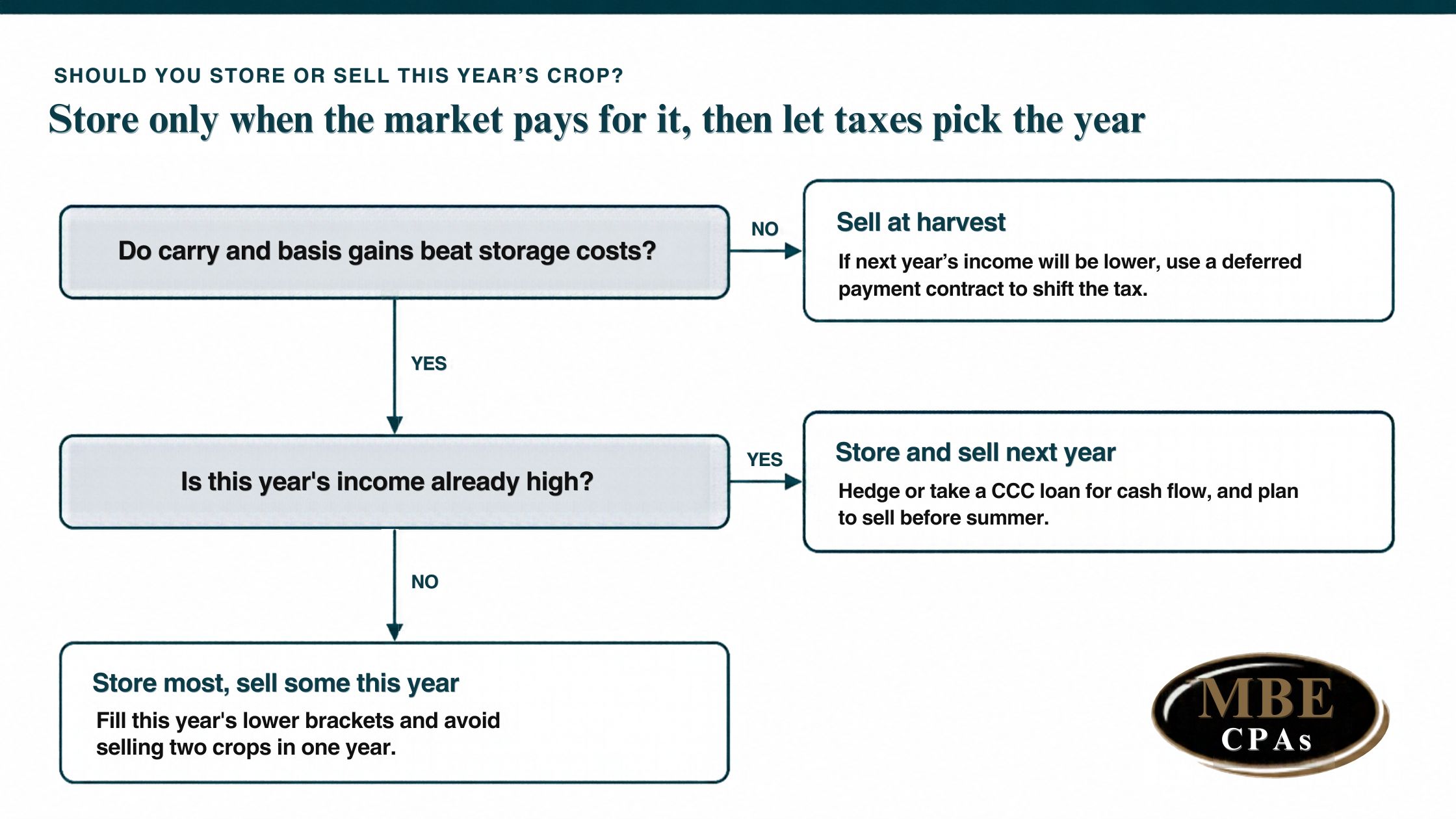
If the storage math doesn’t work, tax timing can still be managed with a deferred payment contract instead of a bin.
What should you check before year-end?
Run through these questions with your CPA and your grain marketer before December:
- What’s my projected taxable income this year, and what does next year look like?
- Does the market’s carry and expected basis gain cover my true storage cost per bushel?
- How much of last year’s crop am I still selling this year?
- Are my deferred payment contracts signed before delivery, with payment dates in writing, and have I avoided advances from the buyer?
- Is the buyer financially sound, and does my state’s indemnity fund cover the contract?
- Are my hedges identified in writing the day I enter them, sized to my production, and timed with the grain sale?
- Have I decided whether to treat CCC loans as loans or income?
- Would income averaging, prepaid inputs, or cooperative sales manage income better than storage alone?
Key takeaways
- Store when carry and basis gains beat your true storage cost. Tax timing is a bonus, not the reason.
- Cash-basis farmers control which year grain income lands in. Accrual filers mostly don’t.
- Deferred payment contracts must be in writing before delivery, and they carry buyer credit risk.
- Identified hedges produce ordinary gains and losses, but their timing can split from the grain sale.
- CCC loans give you cash without a sale. The Section 77 income election applies to later loans until you file to change it.
Next step: Pull your projected income for this year and next, then plan grain sales and taxes together before harvest is in the bin. MBE CPAs’ agribusiness team can help you model your options.
Frequently asked questions
Is grain in storage taxable before I sell it?
For cash-basis farmers, no. Grain income is reported when you’re paid, so unsold grain in the bin on December 31 isn’t taxable that year. For accrual-basis farmers, stored grain is inventory; depending on the inventory method, its value may already be reflected in this year’s income.
Can I ask the elevator to hold my check until January?
Not after delivery. To defer income, you need a written deferred payment contract in place before or at delivery, with no right to demand payment early. A request made after delivery can be treated as constructive receipt, which makes the income taxable now.
Are losses on grain hedges deductible?
Yes. True hedges, meaning futures and options that protect grain you grow or store, produce fully deductible ordinary losses on Schedule F. Identify each hedge in your records the day you enter it. Speculative positions produce capital losses, which can offset capital gains plus only $3,000 a year of other income.
Is a CCC marketing loan taxable income?
Not by default. Loan proceeds are treated as a loan, and you report income when you sell the grain. You can elect under Section 77 to report CCC loans as income in the year received. Once made, the election applies to later loans until you file a change in accounting method, which the IRS grants automatically.
How long should I store grain?
It depends on carry, basis, and your costs, but history favors shorter storage. A University of Illinois farmdocDAILY analysis found that storing corn and soybeans past June generally isn’t profitable.