You maxed out your 401(k) this year. The full $24,500 came out of your paychecks, your employer match landed on schedule, and by any standard, you did the responsible thing.
But you still have money left over that you want to put toward retirement.
This is where most people stop. They assume the 401(k) is tapped out, so anything extra goes into a taxable brokerage account, where it’s exposed to capital gains tax every year it grows. That’s not wrong, it’s just incomplete. If your plan allows, there’s another lever inside your 401(k) that many employees never touch. After-tax contributions and the conversion strategy that turns them into a mega backdoor Roth.
In this blog, we’ll walk through what it is, how the numbers work, and, importantly, when it doesn’t work at all.
What Is a Mega Backdoor Roth?
A mega backdoor Roth is a powerful strategy that lets you contribute beyond the standard $24,500 employee deferral limit. It works by making after-tax, non-Roth contributions to your 401(k) and then converting those dollars to Roth, either inside the plan or by rolling them out to a Roth IRA.
This strategy isn’t for everyone, and it’s not available in every plan. It’s designed for people who:
- Have already maxed out their regular elective deferrals (pre-tax or Roth)
- Want to save more toward retirement with tax-advantaged treatment
- Have a 401(k) plan that explicitly allows after-tax contributions and either in-plan Roth conversions or in-service withdrawals
If your plan doesn’t offer that last feature, this strategy won’t work for you (details below).
What’s the Difference Between Traditional, Roth, and After-Tax Contributions
These three contribution types often get lumped together, but they’re taxed differently now and at withdrawal.
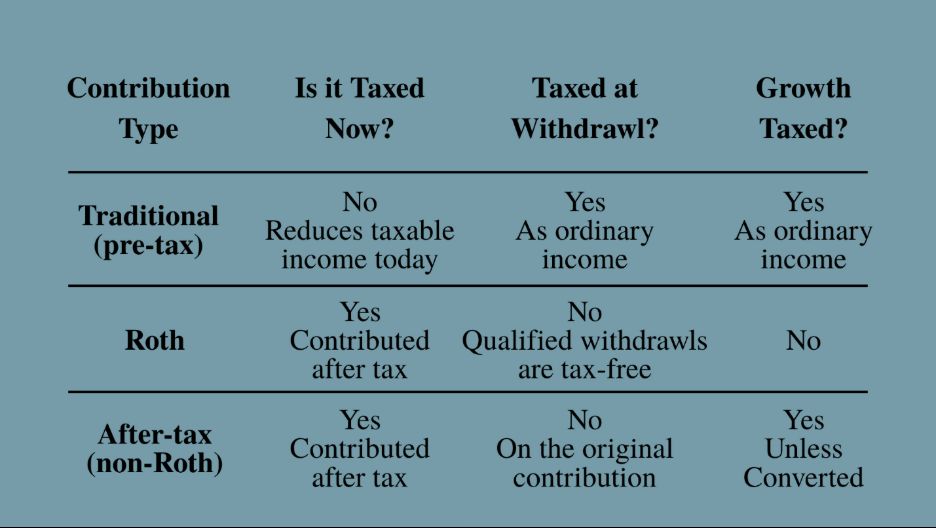
The after-tax type is unique. Because you’ve already paid taxes on your original contribution, you can withdraw those funds tax-free. However, any earnings grow tax-deferred and are taxed as ordinary income when you take them out, unless you convert the balance to Roth before the earnings accumulate. That conversion is the core of the strategy.
What are the 2026 401(k) Contribution Limits?
The IRS numbers you need to know for 2026:
- Employee elective deferral limit: $24,500 (pre-tax and Roth combined)
- Catch-up contribution (age 50+): an additional $8,000, for a total of $32,500
- Enhanced catch-up (ages 60–63): an additional $11,250 instead of $8,000, for a total of $35,750
- High earner Roth catch-up rule: If your FICA wages last year exceeded $150,000, your age-based catch-up contributions must be Roth, not pre-tax.
- Total annual additions limit (Section 415(c)): $72,000, which counts everything, your elective deferrals, employer match, employer profit sharing, and after-tax contributions ($80,000 if you’re 50 or older, with catch-up included).
That $72,000 ceiling is the key number here. It’s not just about your own contributions. It’s everything that goes into the plan on your behalf each year. The gap between what you and your employer have already contributed and that $72,000 cap is your available after-tax contribution room.
How Does This Work in Real Numbers?
Let’s look at an example. Sarah, age 42, earns a $200,000 salary. Her employer matches 4% of her pay, contributing $8,000 per year. Sarah’s 401(k) plan allows after-tax contributions and offers quarterly in-plan Roth conversions.
Here’s how her 2026 contributions compare to the $72,000 total annual additions limit:
- Employee elective deferral (max) = $24,500
- Employer match = $8,000
- Subtotal = $32,500
- Remaining room under $72,000 cap. = $39,500
In this situation, Sarah can contribute up to $39,500 in after-tax, non-Roth dollars this year, in addition to the $24,500 she’s already deferring. That’s over $60,000 going into her 401(k) for the year. Money that would otherwise be taxed as ordinary income or remain in a taxable brokerage account.
If she converts that $39,500 to Roth before it earns significant investment growth, she may pay little to no additional tax on the conversion, and that money could potentially grow tax-free for much or all of her working life and retirement.
This strategy is called the mega backdoor Roth. It’s not a separate account or a special IRS form. It’s a process: contribute after-tax dollars, convert to Roth, and repeat as allowed by the plan.
Do You Have to Convert After-Tax Contributions to Roth?
If you contribute after-tax dollars and simply leave them in the plan, you haven’t truly gained much. While your original contribution can be withdrawn tax-free, any earnings will grow tax-deferred and be taxed as ordinary income when withdrawn, defeating the core benefit of this strategy.
The conversion is what makes it a Roth strategy. Once you convert, all future growth on that money is tax-free, not just tax-deferred, provided you meet the standard Roth rules (holding the account for at least five years and reaching age 59½, or qualifying for an exception like death, disability, or a first-home purchase). It’s important to convert promptly (ideally on a set schedule, like monthly or quarterly) because any earnings accumulated before the conversion are taxable at the time of conversion. Convert promptly, and there’s little to no tax gain. Wait a year, and you could owe real money on the growth.
If your plan offers automatic or scheduled in-plan conversions, use that feature. If it doesn’t, this becomes a manual task you need to stay on top of. Forgetting to do it is a common way to undermine your own strategy.
When Does a Mega Backdoor Roth Not Work?
This strategy gets a lot of attention online, but it isn’t a one-size-fits-all solution for every high earner. Here are some reasons it might not work for you:
- Your plan doesn’t allow after-tax contributions. Not all 401(k) plans offer this feature. It’s determined by your employer’s plan design, not something you can opt into individually.
- Your plan doesn’t allow in-plan conversions or in-service withdrawals. Without one of these, your after-tax contributions have no path to Roth status while you’re still employed there. They just sit as after-tax funds, accumulating taxable earnings.
- Nondiscrimination testing limits how much you can contribute. 401(k) plans that aren’t structured as safe harbor plans must pass IRS nondiscrimination tests (ADP/ACP) each year. If highly compensated employees as a group contribute too much relative to everyone else, the plan may have to limit or refund contributions. Sometimes, after the fact, leading to unexpected tax issues.
- You forget to convert. Without a system in place, after-tax contributions can quietly sit and accumulate taxable earnings for years. Instead of building a mega backdoor Roth, you end up with a less useful after-tax account.
FAQ
What is a mega backdoor Roth? A strategy where you make after-tax, non-Roth contributions to your 401(k) beyond the standard deferral limit, then convert those contributions to Roth so they can grow and be withdrawn tax-free.
Who qualifies for after-tax 401(k) contributions? Anyone whose plan allows after-tax contributions can generally take advantage, but the strategy is most useful for high earners who have already maxed out their regular elective deferrals and have room left under the $72,000 total annual additions limit.
Do I need my plan to allow this? Yes. Your 401(k) must specifically permit after-tax, non-Roth contributions and offer either in-plan Roth conversions or in-service withdrawals so those after-tax dollars can become Roth money.
How is this different from a regular backdoor Roth IRA? A standard backdoor Roth IRA involves contributing to a traditional IRA (typically because your income is too high to contribute to a Roth IRA directly) and converting it, capped at the annual IRA limit of $7,500. A mega backdoor Roth occurs within your 401(k) and can add tens of thousands of dollars, up to the $72,000 total contribution limit.
Next Steps
The best way to determine if this strategy works for you is to review your plan documents. Bring your latest pay stub and your 401(k) plan document (or summary plan description) to your next planning conversation. We can tell you whether your plan allows after-tax contributions and in-plan conversions, and if it does, how much room you have this year.
Retirement contribution limits, nondiscrimination testing, and plan language change annually and vary by employer. At MBE CPAs, we focus on the details that decide whether a strategy like this will be beneficial for you. We’ll review your plan documents, run your numbers, and help you determine if a mega backdoor Roth makes sense for your situation.
Ready to see if your plan may qualify?