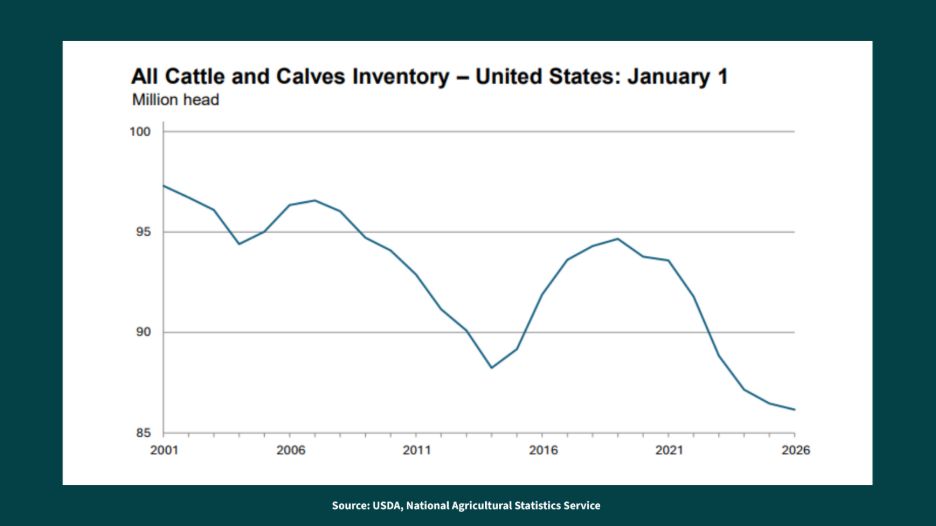
If you’ve been following cattle markets, you already know that the U.S. beef cow herd has shrunk to its lowest point since the 1950s. Decades of drought, rising input costs, and an aging ranching population have quietly hollowed out the nation’s beef supply base, and the effects are rippling through the market.
But here’s what people don’t know. Dairy farmers are now a critical link in the U.S. beef supply chain. The rise of beef-on-dairy crossbreeding isn’t just a niche trend anymore. It’s a shift that’s turning what used to be an afterthought into a way to improve profits.
The opportunity is real, but maximizing it requires coordination. Lasting success in beef-on-dairy relies on genetic selection, market channel strategy, and sharp tax planning working together. Let’s break it down.
What Genetics Should Dairy Farmers Use for Beef-Cross Calves?
Genetics often seem like a cost rather than a source of revenue. However, once you know what buyers truly value and what can lead to deductions, the equation changes quickly.
Feedlot buyers and packers prioritize performance data and predictability. The traits that consistently command premiums are:
- Muscling and ribeye area (the packer’s bottom line)
- Feed efficiency (the feedlot operator’s bottom line)
- Predictable, uniform growth rates (what makes a pen of calves worth a forward contract)
- Calving ease and calf survivability (what protects the dairy farmer’s next lactation)
The risk of using inferior beef semen goes beyond producing a “bad calf.” It can result in a difficult calving event for a high-producing dairy cow, leading to lost milk, higher veterinary costs, or even the loss of the cow.
Should Dairy Farmers Sell Crossbred Calves at the Auction Barn?
Where you sell quality calves matters. Defaulting to the local auction may cost you money in today’s market.
Local auction barns offer fast sales and no planning, but prices can swing, and you have little leverage. Like dairy commodity swings, this unpredictability requires a proactive approach.
Direct-to-feedlot or forward contracts change this. Building relationships with feedlot buyers brings advantages:
- Feedlots can access traceable, consistent genetics
- Can help price uncertainty
- Both sides may realize longer-term value from a consistent working relationship
Feedlot operators are seeking reliable dairy-beef suppliers who can deliver uniform, documented calves. The supply is tight enough that you might have negotiating power you don’t realize.
With value-added premium programs, the concept is simple. Calves that come with documentation can command a higher price than calves that don’t. You may be able to generate more per head by bundling your calves with:
- Age and source verification
- Vaccination protocols
- Maternal breed composition and sire data
- Consistent weaning weight and body condition scores
You may already be keeping the needed records. The key is organizing data so buyers can trust and use it.
What Are the Risks of Forward Contracts and Direct Sales?
Forward contracts and direct-to-feedlot arrangements reduce some uncertainty, but they carry their own risks. If cash prices move above the contracted price before delivery, you give up the upside. If a buyer cannot honor the agreement, you carry counterparty risk. Contracts should specify weight ranges, grading standards, delivery windows, and remedies for non-performance.
Producers who want to manage price risk without a direct buyer relationship may also want to discuss Livestock Risk Protection (LRP) insurance or how a beef-on-dairy program interacts with existing Dairy Revenue Protection (DRP) coverage with their crop insurance agent.
How Does Selling Beef-on-Dairy Calves Affect Your Farm’s Tax Situation?
The cash from a well-run beef-on-dairy program requires a tax strategy to match it. Without planning, even successful farms can face avoidable tax liability.
Cash-Basis Timing
Cash-basis accounting gives you some control over timing. Accelerating sales into a lower-income year, or deferring them into the next year when income is already high, can meaningfully change your tax bill.
Ordinary Income vs. Capital Gains
Are crossbred calf sales taxed as ordinary income or capital gains?
Here’s the core distinction:
- Crossbred calves raised and sold as inventory: taxed as ordinary income.
- Cull cows held for breeding or dairy purposes for 24+ months: may qualify for Section 1231 treatment.
This distinction affects more than just the tax rate. Section 1231 gain is generally not subject to self-employment tax, while income from calves sold as inventory is. For many operations, the self-employment tax difference is a larger dollar impact than the rate difference between ordinary income and capital gains.
The capital gains treatment on a cull cow also depends on how the animal was acquired. If she was raised on the farm, she typically has little or no tax basis, and the 1231 gain calculation is straightforward. If she was purchased and depreciated, part of the gain on sale may be recaptured as ordinary income under Section 1235 to the extent of depreciation claimed. This is worth reviewing animal by animal rather than assuming a blanket capital gains rate applies.
Because 1231 treatment depends on holding period and purpose (breeding or dairy use, not resale), good records showing acquisition date, use, and any depreciation taken will support the position if it’s ever questioned.
Other Farm-Specific Tools Worth Discussing
Farm income averaging (Schedule J) lets eligible farmers spread a high-income year’s tax liability back over the prior three years, which can be a more direct tool than sale timing alone for smoothing out a strong beef-on-dairy year.
Farmers who receive at least two-thirds of their gross income from farming may qualify for the farmer estimated tax exception, allowing a single estimated payment by January 15 or a return filed and paid in full by March 1 instead of quarterly estimates. A strong calf-sale year can change which option makes sense.
Entity Structure
If your operation already separates dairy, crops, or other lines of business into different entities, it’s worth discussing whether a growing beef-cross revenue stream should sit inside the existing dairy entity or be tracked separately. This can affect self-employment tax exposure, liability, and how cleanly you can apply the planning strategies above.
What’s the Outlook for Beef-on-Dairy?
The beef shortage isn’t going to fix itself. Current USDA cattle inventory trends and CattleFax projections suggest the beef cow herd is unlikely to meaningfully rebuild for several years. The supply gap is structural. That means the window for dairy farmers to establish themselves as reliable, quality beef-calf suppliers isn’t closing anytime soon.
The beef-on-dairy relationship works because both sides get something they couldn’t easily get otherwise:
- The dairy farmer may generate a premium revenue stream on calves that used to have limited value, with predictable income through forward contracts.
- The beef producer gains access to calves with documented genetics, consistent health protocols, and more predictable performance.
Ready to Look at How a Beef-on-Dairy Strategy Changes Your Herd’s Tax Outlook?
The strategies in this article are most powerful when they’re built around the specific numbers of your operation. What’s your current herd replacement rate? What’s your income bracket likely to look like this year? How many of your cull cows this year were raised versus purchased and depreciated? When are you planning your next big equipment purchase?
MBE CPAs specializes in working with dairy and beef operations. If you’ve been managing your beef-on-dairy program without a tax plan behind it, including a plan for self-employment tax exposure and depreciation recapture on cull sales, we can help.
Let’s review the numbers before your next quarterly review. Reach out today to schedule a conversation.
This article provides general information about beef-on-dairy programs and related tax considerations. It is not tax, legal, or financial advice, and it doesn’t account for the specific facts of any individual operation. Tax outcomes described here (including capital gains treatment, self-employment tax, and depreciation recapture) depend on how animals were acquired, held, and used, and current law. Talk with your CPA before making decisions based on this article.