
A new executive order directs the IRS to let farmers and truckers run untaxed dyed diesel in highway vehicles through December 31, 2026, without the usual penalties. But the federal tax on that fuel is only being put off, not canceled. Depending on how Treasury writes the rules, the farmer who fills a semi with dyed diesel this fall could still owe 24.4 cents per gallon later.
The order came at a good time for many farm operations. Harvest is one of the busiest and most expensive times of the year, and this fall, diesel prices are adding to the pressure. Global supply is tight, prices have climbed, and every load of grain headed to the elevator costs more to haul. Filling the semi from the farm tank instead of the pump sounds like an easy way to save.
Before you count those savings, it helps to know what the order does and doesn’t cover. Below, we cover who may owe the tax, how the order fits with state rules, and the steps to take now so a future bill doesn’t catch you off guard.
What is dyed diesel, and why can’t it normally go on the road?
Dyed diesel is usually the same fuel you buy at the pump, with red dye added to show it hasn’t been taxed. It’s meant for off-road use, like tractors, combines, irrigation pumps, and generators. Because that equipment doesn’t use public roads, it doesn’t pay the fuel taxes that fund them.
That’s why dyed diesel is normally off-limits in highway vehicles. Federal law requires fuel used on public roads to be taxed, and dyed diesel hasn’t been. Highway diesel carries a federal excise tax of 24.4 cents per gallon, plus state fuel taxes. Putting dyed diesel in a highway vehicle normally triggers a federal penalty of $1,000 or $10 per gallon, whichever is greater. Roadside inspectors can sample a fuel tank, and the red dye makes it easy to spot.
What did the dyed diesel executive order do?
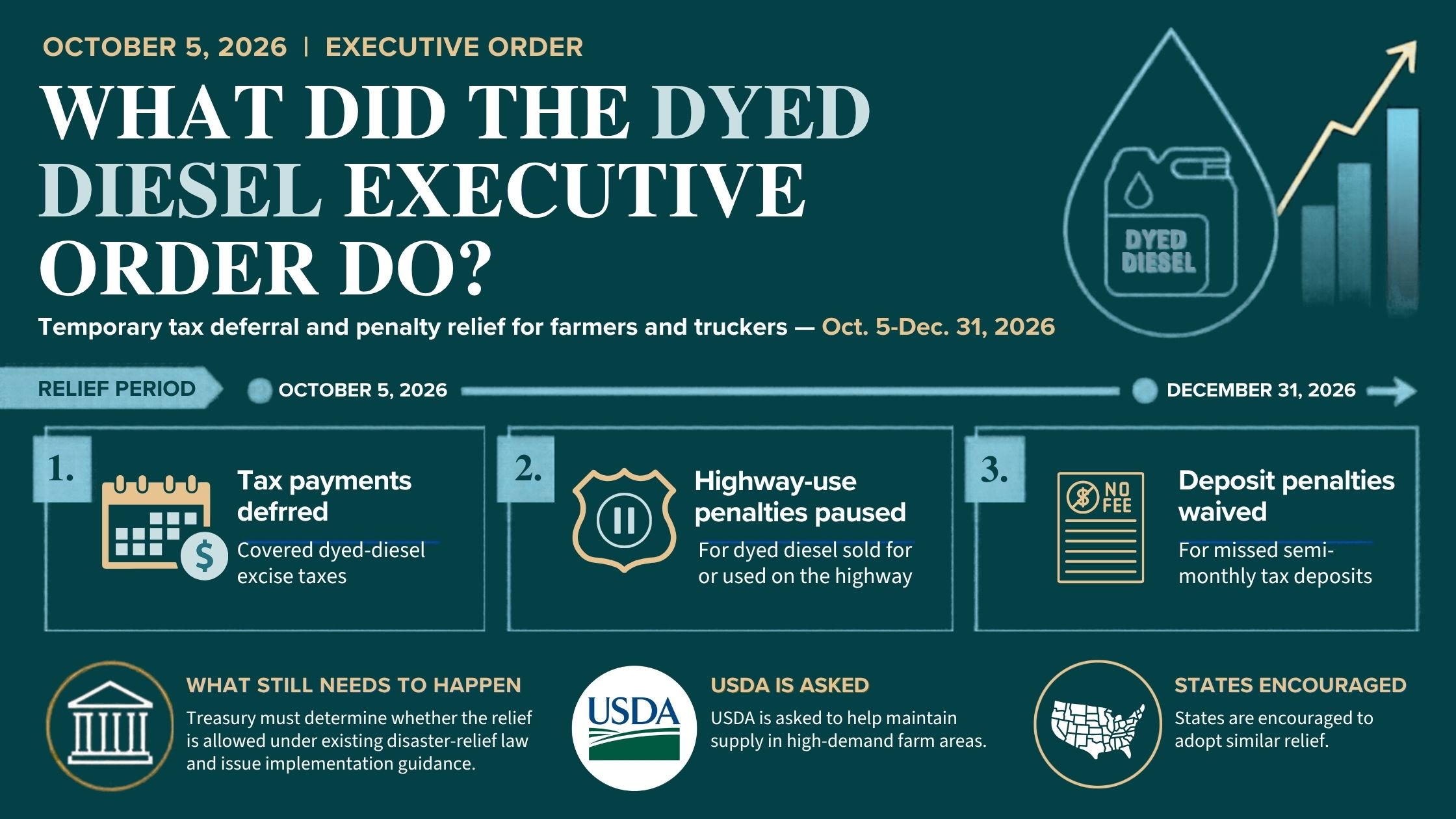
On October 5, 2026, President Trump signed Executive Order 14435, “Emergency Tax Relief on Diesel Fuel.” The order points to restricted global diesel supply and rising prices, and says farmers and truckers have been especially hard hit.
The order does three main things for the period of October 5 through December 31, 2026:
- Defers the federal tax on dyed diesel used on the highway. The deferred tax is to be postponed “without any penalties, interest, additional amount, or addition to the tax,” to the extent the law allows.
- Waives the penalty for using dyed diesel on the road. The IRS is directed not to assess the usual penalty when dyed diesel is sold for or used on the highway.
- Waives penalties for missed tax deposits. It also covers penalties for failing to make semi-monthly deposits of the tax during the same window.
The order also asks the U.S. Department of Agriculture to help keep dyed diesel available in high-demand farm areas, and it encourages states to adopt similar relief.
None of this happens automatically. The order gave Treasury five days to decide whether the relief is allowed under existing disaster-relief law, and Treasury still has to issue guidance on how it works.
Is the dyed diesel tax waived or just deferred?
It’s deferred. The order asks Treasury to “explore avenues, including legislation” to wipe out the deferred tax, but it doesn’t cancel anything. Only Congress can eliminate or change federal fuel taxes, and the order sets no timeline for that to happen.
Kansas State University economist Gregg Ibendahl said he doesn’t believe the administration is “forgiving the tax part of it.” In his view, only the penalty is being waived, and the tax itself would take a vote of Congress to change.
Farm groups are pushing for full forgiveness, and that could still happen. Until it does, the safe approach is to treat the deferred tax as a bill you’ll eventually need to pay.
Who pays the tax on dyed diesel used on the highway?
This is the part that catches people off guard. Dyed diesel skips federal tax at the fuel terminal. When it ends up in a highway vehicle, a backup tax under Section 4041 of the tax code applies instead. That backup tax is the one being deferred.
The person who puts the fuel in the tank and drives it on the road can be the one who owes that tax. Under that section, the tax applies to fuel “used by any person as a fuel in a diesel-powered highway vehicle” when it wasn’t taxed at the time of sale. If you fill your own semi from the farm tank, that person may be you. Fuel suppliers who knowingly sell dyed diesel for highway use may also take on liability. Treasury guidance is expected to spell out exactly who’s covered.
Here’s what that can look like. If your grain trucks burn 2,000 gallons of dyed diesel on the highway between now and year-end, that’s $488 in federal tax that could come due later. A larger operation running several trucks through harvest could see that number climb into the thousands.
How much does this relief help farmers?
For most farm operations, less than the headlines suggest. Most farm fuel already goes into off-road equipment and is already untaxed. The new relief mainly matters for fuel used on public roads, like semis hauling grain, livestock trailers, and diesel pickups.
An analyst quoted by DTN noted the relief is aimed mostly at truckers, local haulers, and diesel pickup owners. For farmers who haul their own crops, the main benefit is cash flow. Putting off 24.4 cents per gallon during harvest frees up money now, but if the tax comes due later, the savings aren’t permanent.
When is the deferred diesel tax due?
The order doesn’t set a date. It leaves the payment deadline, along with who qualifies and under what conditions, to Treasury guidance. Some in the fuel industry expect deferred amounts to be settled up sometime in 2027, but nothing is final.
Until that guidance is out, plan as if the tax will be owed. Track it on your books as money you’ll need to pay, not money you’ve saved. Book as an accrued expense.

Do state fuel tax rules still apply?
Yes, unless your state has acted on its own. The federal order only covers federal tax and federal penalties. State fuel taxes, licensing, reporting rules, and dyed-fuel bans stay in place.
As of early October, ten states had issued emergency relief, according to Energy Marketers of America. The states are Alabama, Arkansas, Indiana, Louisiana, Missouri, Nebraska, North Carolina, North Dakota, Oklahoma, and Texas. Those orders vary. Many are limited to farm vehicles, certain roads, or short time frames. If your truck crosses state lines, a load that’s fine in one state could still draw a penalty in the next.
A few other rules haven’t changed:
- EPA fuel standards still apply. Dyed diesel used in a highway truck should meet the 15 ppm ultra-low sulfur standard that modern on-road engines require.
- Inspections continue. The order directs Treasury to review IRS resources for fuel tank inspections and sampling, and federal trucking enforcement continues, so roadside checks are still possible.
- Tampering is still off limits. Penalties for removing or altering the dye are not covered by the relief.
What should farmers do now?
Here’s what we suggest doing between now and year-end:
- Track every gallon. Log the date, gallons, and vehicle, each time dyed diesel goes into a highway truck from October 5 through December 31. Keep fuel receipts and delivery tickets with your records.
- Keep dyed and clear fuel separate on paper. If you buy both, make sure invoices list them as separate line items so there’s no confusion later.
- Set the money aside. Hold back 24.4 cents per gallon so a future bill doesn’t land at a bad time.
- Check your state’s rules before running dyed fuel on public roads, and check the rules in any state your trucks pass through.
- Confirm your fuel meets on-road standards with your fuel supplier before using it in a highway vehicle.
- Watch for Treasury guidance on who owes the tax and when it’s due.
- Talk with us about how this fits your year-end tax plan and cash flow.
This relief can give farmers some breathing room during a tight harvest. It’s not free money, though. The farmers who keep good records now are in the best position when the bill arrives, and have more options if Congress decides to forgive it.
This article is for general information only and isn’t tax or legal advice. Rules may change as Treasury issues guidance.