
Culver’s is a homegrown Wisconsin brand, and it carries that reputation into every market it enters. Opening one today costs far more than most people would guess. The 2026 Culver’s Franchise Disclosure Document lists a total investment of $3.4 million to $10.3 million to open a single restaurant. For an owner sizing up a new location at any stage of building a Culver’s footprint, the question worth asking isn’t the number itself. It’s what’s driving it, and how you plan around it.
What Does a Culver’s Franchise Disclosure Document Include?
A Franchise Disclosure Document is built to inform, not to advise. It lists what a franchisor requires an owner to pay and what it discloses about performance, but it doesn’t say whether a given market supports that investment, how to structure financing across multiple entities, or what happens to cash flow in a slower opening year. Reading an FDD the way a lender does means pulling out the line items that matter for your situation and running them against your own numbers, not comparing them to a system average.
How Much Does It Cost to Open a Culver’s Franchise?
The Culver’s franchise fee is generally $65,000. It drops to $55,000 for qualifying existing franchisees adding a location, to $45,000 under Culver’s Mentoring Program, and can be reduced by another $10,000 for qualifying veterans. Against a total investment that can reach eight figures, that fee is a small piece of the picture. Most of the $3.4 million to $10.3 million range sits in three categories:
- Land
- Site work
- The building
Each of these varies enormously depending on the market, which is why two owners opening under the same brand can see very different numbers on their construction bids. For a group evaluating a new site, that puts the weight of due diligence on the real estate decision, not the franchise agreement. A strong site with a manageable build cost can move an owner toward the lower end of the range, while a tight urban lot or a market with high construction costs can push a project toward the higher end regardless of how well the restaurant performs later.
How Much Do Culver’s Franchise Owners Pay in Ongoing Fees?
Two fees come out of gross sales on an ongoing basis:
- A 4% franchise royalty fee, which the FDD refers to as the service fee
- A 2.5% marketing fund contribution
Combined, that’s 6.5% of revenue paid out before payroll, food cost, or rent. That percentage doesn’t shrink during a slower month, so it’s worth modeling against a conservative month rather than an average one, particularly for a location still building its customer base. A 6.5% fee structure is lower than some national quick-service brands charge, which helps explain why Culver’s unit economics tend to look attractive on paper. It’s still a cost against revenue rather than profit, and for a group running several locations, it’s worth building into the cash flow plan for every unit, not just the ones that are already established.
How Much Working Capital Do You Need to Open a Culver’s Franchise?
The FDD also includes a line for additional funds needed to cover roughly the first three months of operation, with current estimates ranging from $65,000 to $120,000 per location. It’s meant to bridge the gap between opening day and the point where a store’s cash flow settles into a steady pattern, and it’s an easy number to underestimate. For a group opening a new location while an existing one is still ramping up, spreading that reserve too thin across several entities can strain the whole portfolio if it isn’t sized correctly ahead of time.
Does Culver’s Disclose Franchisee Profit in Its FDD?
Culver’s reports average and median gross sales in Item 19 of its FDD, and the median has landed around $4.04 million. That number gets cited often because it’s a strong one, amid Culver’s expansion to 1,034 franchised locations as of year-end 2025. What it doesn’t show is what an owner keeps after rent or debt service, labor, and the royalty and marketing fees come out. Culver’s doesn’t disclose franchisee profit in its FDD, so a strong gross sales figure at one location can sit next to a thin margin depending on lease terms, financing structure, and labor costs. A location in a lower-cost market with a favorable lease can end up more profitable than a higher-revenue location carrying heavier debt or rent, even though the FDD alone wouldn’t show that difference. Before committing capital to a new location or a new development agreement, it’s worth having those numbers reviewed against your own operating structure rather than the system average.
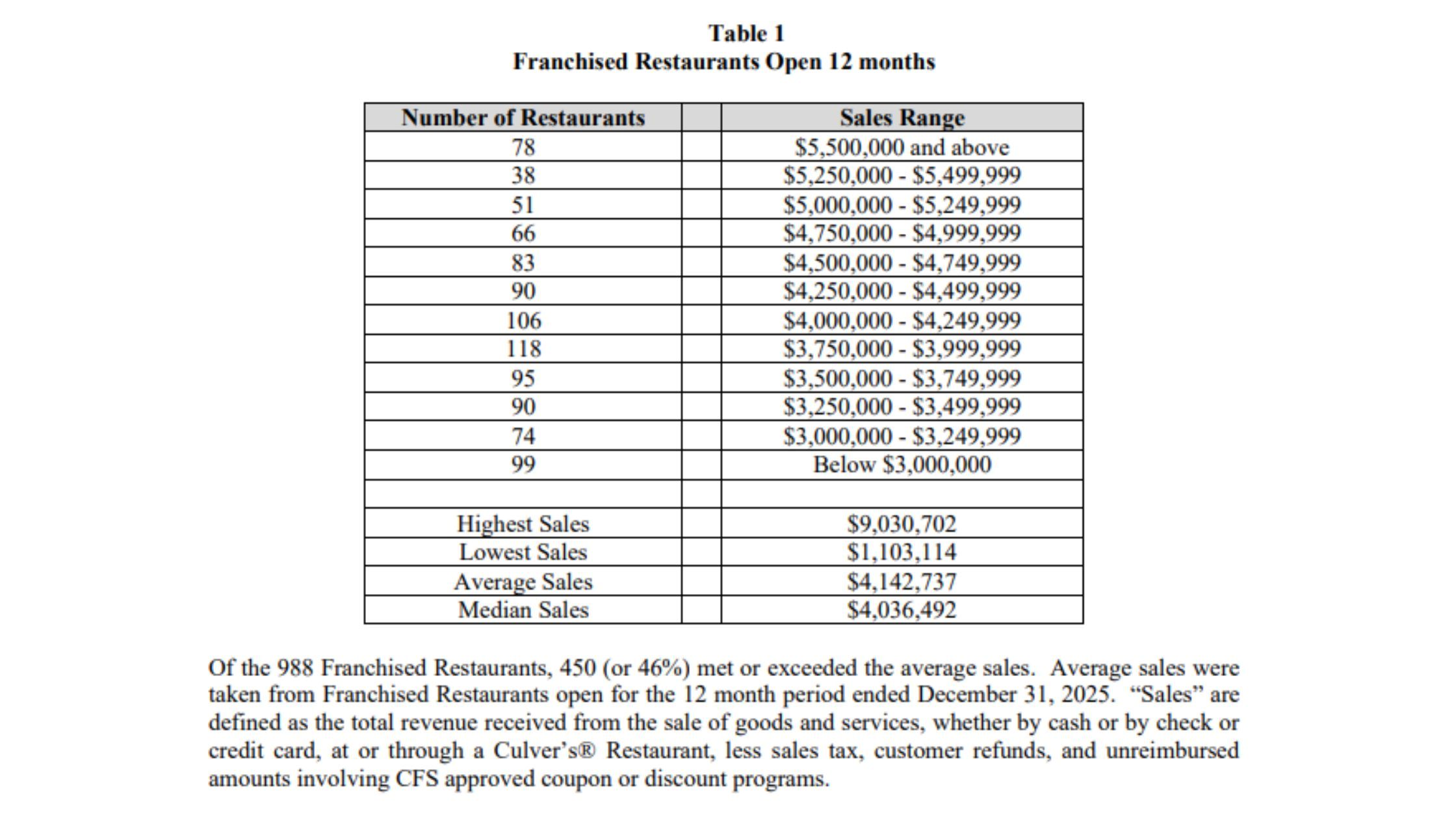
Culver’s Franchise Disclosure Document, 2026
What Does This Look Like in Practice?
Here’s how these figures interact for one location, using round numbers within the disclosed ranges as an illustration rather than a forecast for any specific site. Say a group is evaluating a new location with a total investment landing near $6.8 million, roughly the midpoint of the $3.4 million to $10.3 million range. If that location’s gross sales come in near the system median of $4.04 million, the 4% royalty, also referred to as the service fee, and 2.5% marketing fund contribution add up to about $262,000 a year, or 6.5% of revenue, before payroll, food cost, rent, or debt service on the $6.8 million project.
Add the additional funds line for the first three months of operation, and the group needs another $65,000 to $120,000 in cash beyond the build cost just to open the doors. None of this tells the owner what’s left over once financing costs and labor come out, because the FDD doesn’t disclose franchisee profit. That’s the layer that determines whether the project holds up on this owner’s balance sheet, not just on the strength of Culver’s system-wide numbers.
Ready To Review Your Culver’s Numbers Before You Sign?
A Franchise Disclosure Document hands you a number. It doesn’t tell you whether that number fits your financing, your timeline, or the entity structure you’re already running. Getting that answer takes the kind of review Culver’s owners have needed at every point along the way: someone checking the figures against your own plans before the ink dries.
MBE CPAs works with Culver’s franchise owners at all stages of growth. Before you sign a new development agreement or walk into a lender meeting, we’re glad to sit down and go through the numbers with you.
This article is for general educational purposes only and is based on publicly available Franchise Disclosure Document data. It’s not financial, legal, or investment advice, and it’s not a solicitation regarding any specific franchise opportunity.